Why Small Gutter Joint Leaks Cause Big Home Damage
When you need to fix rain gutter leaks, the goal is simple: stop water at the seam before it reaches your fascia, siding, or foundation. As a trusted roofing contractor for home exterior water protection, we see most gutter leaks start at joints, seams, and corners — not in the middle of a gutter run. The good news is that most of these leaks are fixable with the right sealant and about an hour of careful work.
How to fix rain gutter leaks — quick answer:
- Clean the leaking joint with a wire brush and remove all old sealant
- Dry the surface completely before applying anything
- Apply butyl rubber or tripolymer sealant along the interior seam
- Tool the bead into a smooth, concave shape
- Wait 24–48 hours, then test with a garden hose
If the leak is coming from a hole rather than a seam, roofing cement or an aluminum patch is the right fix. If your gutters are sagging, rusted through, or over 20 years old, replacement may be the smarter call.
Ignoring even a small gutter joint leak is a real risk. Water dripping behind the gutter can silently rot your fascia board — a repair that can cost anywhere from $500 to $2,000. Chronic leaks that direct water toward your foundation can lead to crack repairs costing $2,000 to $8,000. That’s a steep price for what starts as a drip at a seam.
Gutter leaks are one of the most common reasons homeowners reach out to our professional roof repair services team here in San Antonio — often after the damage has already spread to the fascia or foundation. Catching the problem early and sealing it correctly the first time is always the cheaper path.
I’m Carlos Yzaguirre, President of Apex Roofing & General Contractors — a San Antonio-based roofing firm I co-founded in 2022. Over the years, I’ve seen how a failure to fix rain gutter leaks early turns into costly structural repairs, and this guide covers everything you need to handle the job right the first time.
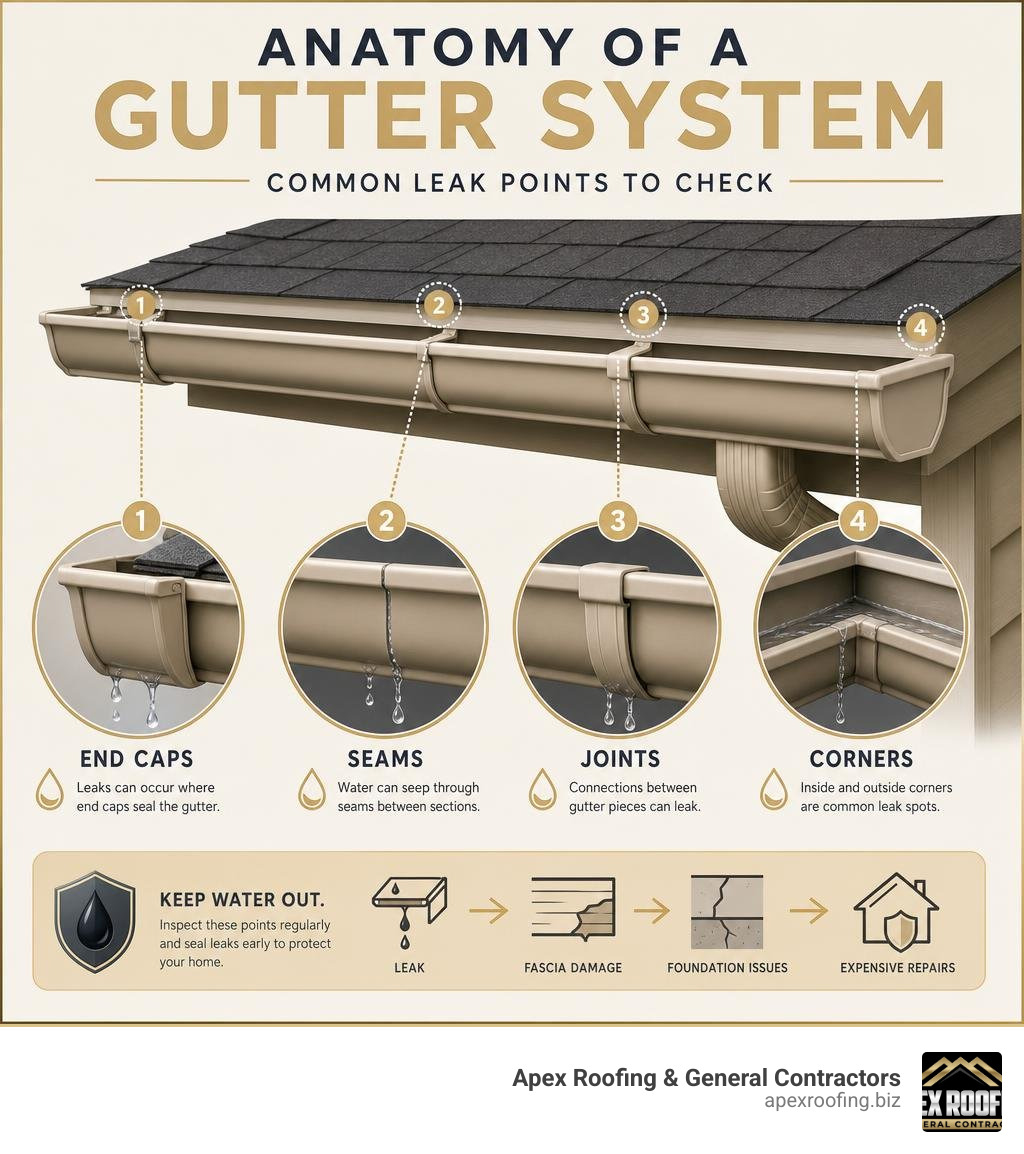
Discover more about fix rain gutter leaks:
Common Causes of Gutter Joint Leaks
To permanently fix rain gutter leaks, you must first understand why they happen. Sectional gutters have a joint every 10 to 12 feet on average, and each one of these connections is a potential failure point. In fact, industry data shows that 99% of all gutter leaks occur at joints, seams, and corners.
The primary driver behind joint failure is thermal expansion. Aluminum gutters expand and contract significantly with temperature changes. In San Antonio, where summer temperatures regularly soar past 100°F and winter nights can dip below freezing, this constant movement puts immense stress on gutter seams. Over time, the physical pulling and pushing break the bond of the sealant, leading to separation.
Other common causes of gutter joint leaks include:
- Sealant Degradation: Standard gutter sealants only last about 10 to 20 years under normal wear and tear. Butyl-based sealants typically last 5 to 10 years, and harsh climates with extreme temperature swings can reduce that lifespan to 3 to 7 years.
- Standing Water: If gutters are not sloped correctly, water pools in the low spots. Standing water accelerates sealant breakdown and triggers rust or corrosion in metal gutters.
- Improper Gutter Slope: A properly installed gutter should slope exactly 1/4 inch for every 10 feet toward the downspout. If the slope is too flat or runs backward, water pools, submerging the joints and causing them to fail.
- Clogged Downspouts: Debris like leaves, twigs, and roofing granules back up water inside the gutter. This extra weight causes the system to sag, which pulls joints apart and forces water over the back of the gutter.
- Fascia Board Rot: When water leaks behind the gutter due to a missing drip edge, it rots the wood fascia. Loose fascia boards cannot hold gutter hangers securely, leading to sagging runs that stress and break the joint seals.
If you are dealing with sagging sections along with your leaks, you can learn how to correct these structural issues in this guide on How to DIY Fix Gutters: Sagging & Leak Repair (2026) – solvehacks.com.
Essential Tools and Materials to Fix Rain Gutter Leaks
Before climbing up to your roofline, gather the correct tools and materials. Using the wrong sealant or skipping prep tools guarantees the repair will fail within a single season.
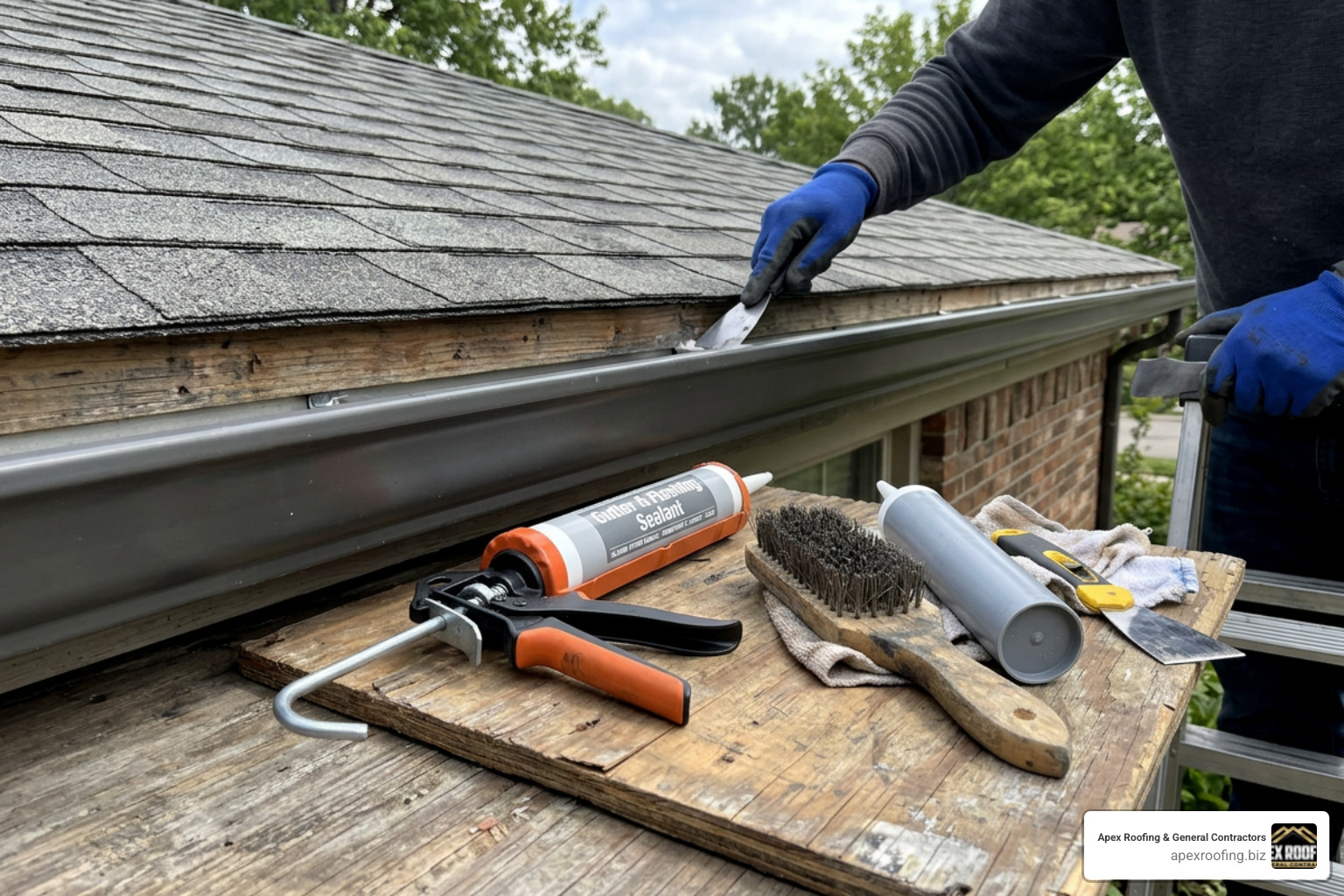
To successfully fix rain gutter leaks, you will need:
- High-Quality Sealant:
- Tripolymer Sealant: (such as Geocel 2320) This is the gold standard for gutter repair. It offers up to 900% elongation, handles extreme thermal expansion, and can even adhere to slightly damp surfaces.
- Butyl Rubber Sealant: Excellent for aluminum and steel gutters. It remains highly flexible and bonds reliably under constant moisture exposure.
- Silicone or Polyurethane Caulk: Use exterior-grade, high-movement varieties designed specifically for gutter applications.
- Caulk Gun: For smooth, controlled application of your sealant.
- Wire Brush and Putty Knife: Essential for scraping away old, crusty sealant, dirt, and rust.
- OSHA Type IA Ladder: A heavy-duty ladder rated for 300 lbs capacity to ensure your safety.
- Work Gloves and Safety Glasses: To protect your hands from sharp metal edges and your eyes from falling debris.
- Aluminum Flashing Patches: For repairing larger rust holes.
- Pop Rivets or 1/4-inch Hex Head Screws: To mechanically secure loose joints before sealing.
For a detailed breakdown of sealant options, check out this How to Seal Gutter Joints Properly (Step-by-Step Guide).
Step-by-Step Guide to Sealing Leaky Gutter Joints
Sealing a leaking joint is a straightforward DIY project, but it requires patience and attention to detail. Follow this step-by-step process to ensure a long-lasting, watertight seal.
Step 1: Clean the Gutter Thoroughly
You cannot seal a dirty gutter. Scoop out all leaves, mud, and organic sludge. Use a garden hose to flush out remaining dirt. Focus heavily on the area around the leaking joint.
Step 2: Remove All Old Sealant
Applying new sealant over old, failed sealant is the most common DIY mistake. The new material will only bond to the old, brittle caulk, not the gutter metal, causing it to peel away quickly. Use a putty knife or scraper to remove every bit of the old sealant. Scrape until you reach bare metal or vinyl.
Step 3: Prep the Surface
Scrub the joint area with a wire brush or abrasive pad to remove any remaining residue or light rust. Wipe the area down with rubbing alcohol or acetone to remove oils and fine dust.
Step 4: Dry the Joint Completely
Most sealants require a completely dry surface to cure and bond correctly. Wipe the joint down with a clean towel and let it air-dry in the sun. If you are in a rush, a hair dryer can speed up the process.
Step 5: Apply Sealant from the Interior
Always seal gutter joints from the inside. Water flows on the inside of the gutter; sealing the outside does not stop water from entering the seam, where it will eventually freeze, expand, and push the patch off. Apply a continuous, generous bead of sealant along the interior seam, spreading it from one edge to the other and extending at least two inches beyond the seam on both sides.
Step 6: Tool the Bead
Using a gloved finger or a caulking tool, press and smooth the sealant into the joint. You want a concave profile that forces the sealant deep into the seam while keeping the edges thin so water can flow over it without obstruction.
Step 7: Allow Proper Curing Time
Let the sealant cure according to the manufacturer’s instructions. This typically takes 24 to 48 hours. Avoid running water through the system during this window.
Step 8: Test the Repair
Once fully cured, place a garden hose at the high end of the gutter run and let water flow past the repaired joint. Inspect the underside of the seam to confirm it is completely watertight.
How to Safely Prep Your Roofline to Fix Rain Gutter Leaks
Safety must be your top priority when working on a ladder. Before you begin scraping or sealing, ensure your work area is safe and your gutters are structurally sound.
- Ladder Safety: Always place your ladder on stable, level ground. Use a ladder stabilizer (stand-off bracket) to prevent the ladder from resting directly against the gutter, which can bend or crush the aluminum. Never stand on the top two rungs of a step ladder.
- Clear the Clogs First: Ensure all downspouts are completely clear. A clogged downspout holds heavy standing water that stresses the entire system.
- Perform a 4-Step Fascia Board Integrity Check:
- Visual Inspection: Look for water stains, peeling paint, or mold on the fascia board behind the leaking joint.
- Physical Probe Test: Take a screwdriver and gently poke the wood. If the wood feels soft or spongy, rot has set in.
- Fastener Pull-Test: Check if the gutter spikes or screws are pulling out of the wood.
- Structural Assessment: If the fascia is rotted, it must be replaced before you can safely anchor and realign your gutters.
If you discover rotted fascia or structural sagging that goes beyond a simple joint seal, consider calling in professional gutter and roof repair handyman services to handle the structural woodwork safely.
Applying Sealant to Gutter Seams and Miters
Miter joints (the corners of your gutters) are highly vulnerable to leaks because they receive heavy, concentrated water flow from roof valleys.
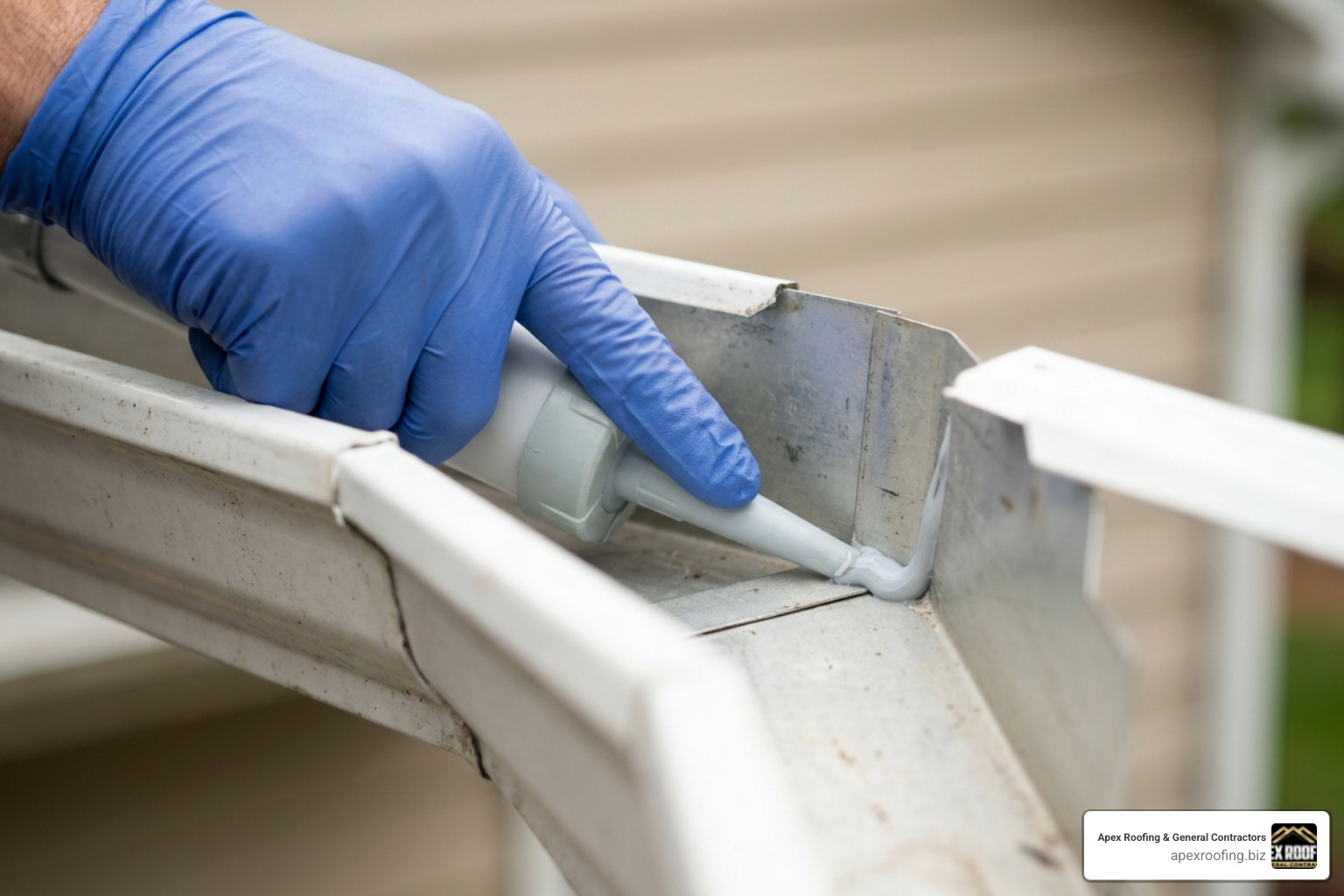
When sealing miters and seams, keep these best practices in mind:
- Use Mechanical Fasteners: If the joint has physically separated due to thermal expansion, do not rely on sealant alone to hold it together. Secure the joint mechanically using pop rivets or 1/4-inch hex head galvanized screws before applying caulk.
- Spread the Sealant Generously: Apply the sealant at least two inches on either side of the seam. This creates a wide waterproof bridge that can accommodate the metal’s natural expansion and contraction.
- Avoid Exterior-Only Sealing: We cannot stress this enough: applying caulk to the outside bottom of a leaking corner is a temporary band-aid. Water will still seep into the seam from the inside, trapping moisture against the metal and causing rapid failure. Always seal from the interior.
Repairing Gutter Holes: Small Pinholes vs. Large Rust Patches
While joint leaks are common, you may also find physical holes in your gutter system caused by rust, corrosion, or falling branches. The repair method depends entirely on the size of the hole.
Fixing Small Pinholes
Small pinholes (often caused by minor rust spots on older steel gutters) are simple to fix:
- Use a wire brush to scrub away all rust surrounding the pinhole until you see clean, shiny metal.
- Apply a rust-inhibiting metal primer to prevent the corrosion from spreading.
- Apply a dollop of polyurethane sealant or roofing cement directly over the hole.
- Smooth the patch down with a putty knife, feathering the edges so water flows smoothly over it.
Patching Large Holes
For holes larger than a dime, you will need to apply a metal patch:
- Clean and de-rust the area thoroughly, then apply a metal primer.
- Cut a patch out of aluminum flashing using tin snips. Make sure the patch is at least one inch larger than the hole on all sides.
- Apply a thick layer of plastic roofing cement or heavy-duty gutter sealant around the edges of the hole on the inside of the gutter.
- Press the aluminum patch firmly into the cement, embedding it completely.
- Apply another layer of roofing cement or sealant over the top of the patch, using a putty knife to feather the edges flat against the gutter floor.
- Once dry, paint the exterior of the gutter with rust-resistant paint to match your home’s trim.
For more visual examples and advanced patching techniques, refer to this guide on How To Repair a Leaky Gutter – This Old House.
When to Repair vs. Replace Your Gutter System
Not every gutter system can be saved with a tube of sealant. Knowing when to transition from DIY repairs to a full replacement will save you time, money, and headache.
| Feature / Condition | Repair Makes Sense | Replacement is Best |
|---|---|---|
| Gutter Age | Under 15 years old | Over 20 years old (Aluminum) or 15 years (Vinyl) |
| Leak Locations | 1 or 2 isolated joint leaks | Multiple failing joints across the entire system |
| Physical Damage | Small pinholes, loose hangers | Extensive rust, major cracks, crushed sections |
| System Structure | Sectional gutters in good alignment | Brittle vinyl, severe sagging, outdated spike-and-ferrule |
If your system is over 20 years old and constantly leaking at multiple seams, it is time to upgrade. Modern seamless aluminum gutters are custom-formed on-site to the exact dimensions of your roofline. Because they only have joints at the corners, they eliminate the seams where 99% of leaks occur, providing a highly reliable, low-maintenance solution.
If you are ready to explore your options, you can find details on custom systems and pricing through our gutter installation in San Antonio service page.
Proactive Maintenance Tips to Fix Rain Gutter Leaks Permanently
The best way to fix rain gutter leaks is to prevent them from happening in the first place. A small amount of routine maintenance will double the lifespan of your gutter system.
- Stick to a Bi-Annual Cleaning Schedule: Clean your gutters at least twice a year — once in the spring and once in the late fall. If your property has heavy tree cover, you may need to clean them more frequently.
- Install Micro-Mesh Gutter Guards: Avoid cheap plastic screens that collapse under heavy wet leaves. High-quality, micro-mesh aluminum gutter guards keep leaves and pine needles out of your system while drawing rainwater in via surface tension.
- Maintain the Correct Slope: Periodically check your gutter slope. A slope of 1/4 inch per 10 feet is required to keep water moving toward the downspouts and prevent standing water from eating away at your joint sealant.
- Extend Your Downspouts: Ensure all downspouts terminate at least 5 feet (ideally 10 feet) away from your home’s foundation to protect your basement, crawlspace, and slab from erosion.
For residents living in the surrounding Hill Country, you can read our localized maintenance advice in this guide to gutter maintenance in Helotes.
Frequently Asked Questions About Gutter Leak Repair
Can you seal gutters while they are wet or raining?
No, you should not attempt to seal gutters while they are actively wet or raining. Most standard silicone, polyurethane, and butyl rubber sealants require a completely dry surface to achieve proper adhesion. If applied to a wet surface, the sealant will fail to bond and will peel away as soon as water flows over it.
However, if you must perform an emergency repair during a storm, look for a specialized tripolymer sealant (like Geocel 2320). Tripolymer formulas have a high damp-surface tolerance and can adhere to wet metals, though drying the area first is still highly recommended for a permanent fix.
What is the best sealant for DIY gutter joint repair?
The best sealant for DIY gutter joint repair is a tripolymer sealant or a butyl rubber sealant.
- Tripolymer sealants offer incredible flexibility (up to 900% elongation), which is crucial for handling the thermal expansion of metal gutters. They also resist UV rays and handle constant water submersion.
- Butyl rubber is highly durable, budget-friendly, and creates a fantastic waterproof bond on aluminum and steel gutters.
- Avoid standard household silicone caulk, as it lacks the necessary elongation and tends to peel away from aluminum within a few seasons.
Why is water leaking behind my gutters if they aren’t clogged?
If water is dripping behind your gutters even though they are completely clear of debris, the culprit is almost always a missing or improperly installed drip edge (gutter apron).
Without a metal drip edge tucked under your shingles and over the back edge of the gutter, surface tension will draw rainwater backward, forcing it to run down your fascia board and behind the gutter. Installing gutter apron flashing is the only permanent solution to this issue.
You can read more about how this system protects your roofline in our article on the importance of gutter maintenance for Austin homes.
Conclusion
Sealing leaky gutter joints is a highly rewarding DIY project that can save you thousands of dollars in foundation and fascia repairs. By thoroughly cleaning the joint, removing old sealant, and applying a high-quality tripolymer or butyl rubber sealant from the inside of the gutter, you can restore your system’s integrity and keep rainwater moving safely away from your home.
However, ladder work is inherently dangerous, and diagnosing complex slope issues, rotted fascia boards, or widespread rust requires professional expertise.
If your gutters are sagging, rusted through, or you simply prefer to keep your feet safely on the ground, Apex Roofing & General Contractors is here to help. We provide certified, reliable gutter repairs and seamless gutter installations throughout the San Antonio area, ensuring complete compliance with local building codes and transparent communication from start to finish.
Let our team handle the dirty work. We offer free estimates on all our services. To schedule a professional roof and gutter inspection, visit our schedule a professional roof and gutter inspection page or call us directly at (726) 727-7663 for a free inspection.