Flat Roof Patching: Stop Small Leaks Before They Spread
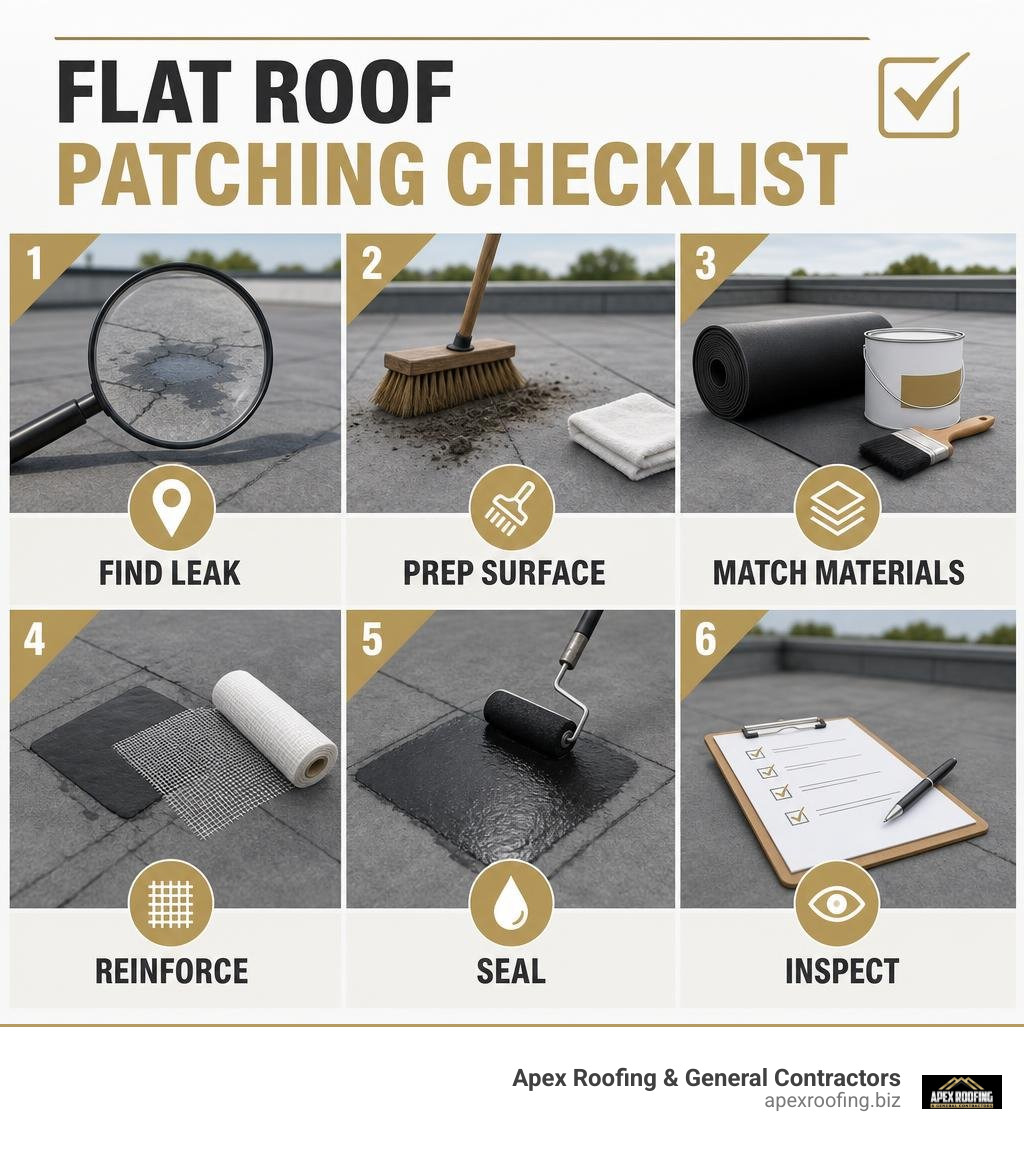
Flat roof patching fixes small, localized leaks by cleaning and drying the damaged area, removing failed material, and applying a patch that matches the existing roof membrane. The best repair starts with finding the true entry point, not simply sealing the spot where water appears indoors, because water can travel sideways through insulation before it reaches the ceiling.
For a fast answer, a durable repair requires three fundamental elements:
- A clean, sound, and dry surface substrate.
- Proper material compatibility across EPDM, TPO, PVC, modified bitumen, or built-up roofing.
- Reinforced structural layering across high-stress seams and roof penetrations.
Flat roofs in San Antonio experience intense thermal movement, severe weather, and ponding water. Property owners seeking lasting protection rely on a trusted San Antonio roofing contractor to evaluate structural risks and apply code-compliant repairs.
I’m Carlos Yzaguirre, President and Managing Partner of Apex Roofing & General Contractors, and I lead residential and commercial roofing work across San Antonio and surrounding Central Texas communities. Our experience with flat roof patching helps property owners address active leaks, storm damage, and worn low-slope roof details with clear, practical repair guidance.
Flat roof patching vocab explained:
Understanding Flat Roof Leaks: Common Causes and Tracing the Source
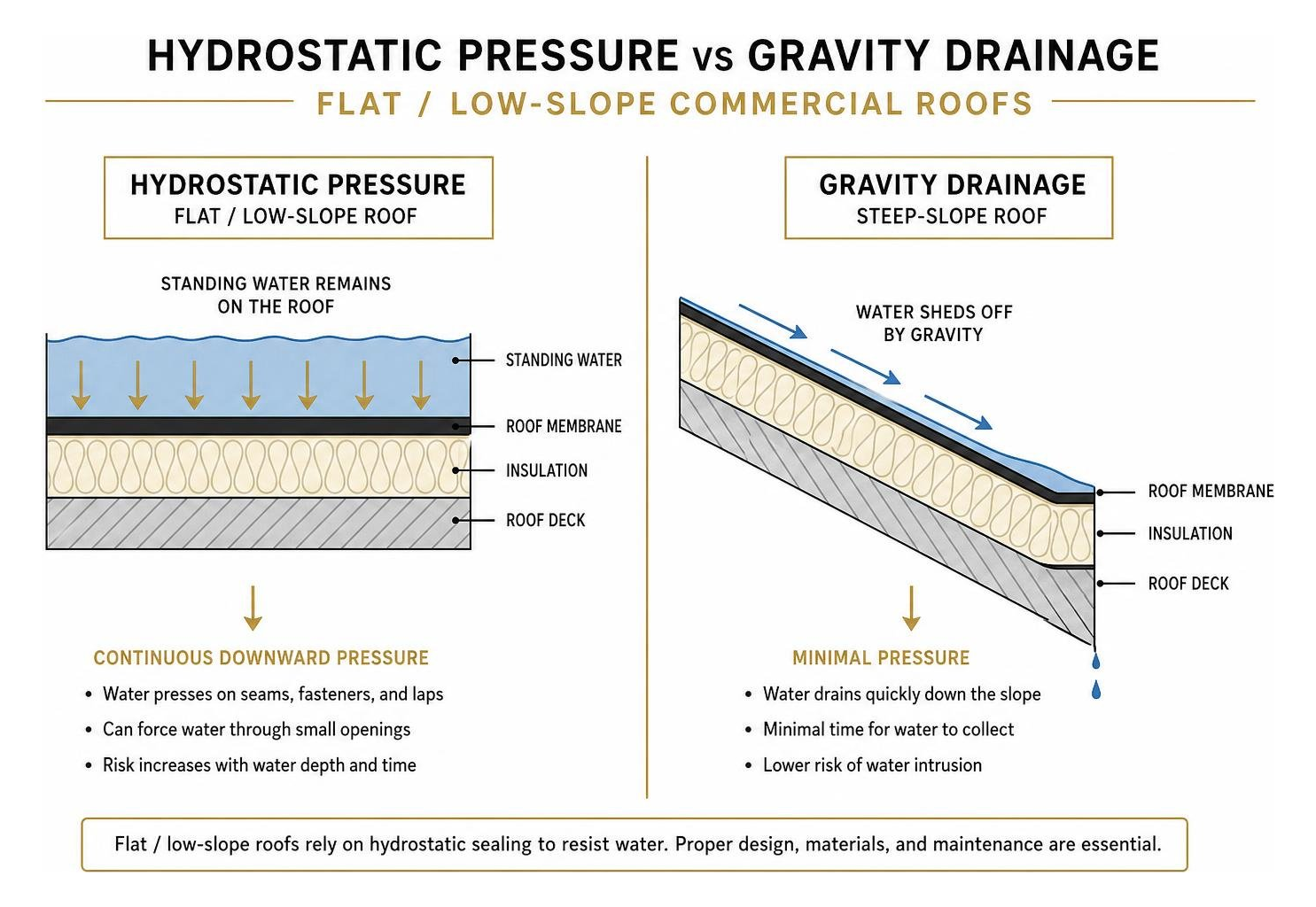
Flat roof leaks stem primarily from ponding water, intense thermal expansion, seam separation, membrane punctures, and elevated hydrostatic pressure. Unlike steep-slope roofs that shed water rapidly via gravity, low-slope assemblies rely on hydrostatic sealing. When standing water remains over an area for more than 48 hours—known as ponding water—it exerts continuous downward force across seams, flashing joints, and mechanical fasteners.
In major South Texas metropolitan regions like San Antonio, extreme climate factors accelerate low-slope roof deterioration. High San Antonio heat/UV load regularly bakes dark roofing membranes, raising surface temperatures above 160°F. When intense afternoon thunderstorms hit, rapid cooling causes thermal shock. This violent cycle forces roof materials to expand and contract repeatedly, splitting aged seams and tearing perimeter flashings. Furthermore, spring hail and high winds push wind-driven rain under loosened laps, while expansive clay soils cause subtle building movement that stresses rigid roof terminations.

Locating the exact source of a flat roof leak requires systematic inspection because water rarely drips straight down. Water migrates laterally through underlying insulation board and timber decking before penetrating an interior ceiling tile. To identify the true entry point, professional inspectors use precise mapping techniques:
- Interior-to-Exterior Mapping: Technicians measure the location of an interior ceiling stain relative to two exterior structural walls, then map those exact coordinates on top of the roof membrane.
- Up-Slope Scanning: Because water flows down the subtle slope of the roof, inspectors examine areas several feet up-slope from the mapped interior stain, looking for hairline punctures, alligatoring cracks, or delaminated seams.
- Advanced Moisture Detection: Non-invasive tools like impedance moisture meters or infrared thermal cameras (conducted at dusk as wet insulation retains heat differently than dry decking) locate hidden moisture reservoirs under sound-looking top membranes.
Ignoring water entry leads to trapped moisture beneath the membrane. Trapped water creates steam pressure under Texas summer heat, causing massive surface blisters, rot in structural decking, and severe structural risk. Learn more about how to stop the drip and fix your leaking flat roof.
Professional Flat Roof Patching Standards: Technical Protocols
Executing a lasting flat roof repair requires strict adherence to professional roofing standards, rigorous substrate evaluation, and confirmed material compatibility. This work is not a homeowner repair tutorial because low-slope roof systems can hide saturated insulation, weakened decking, and incompatible membrane chemistry beneath a surface that appears intact. Attempting unverified quick fixes without understanding moisture entrapment can trap water inside the assembly, accelerating deck rot and structural failure.
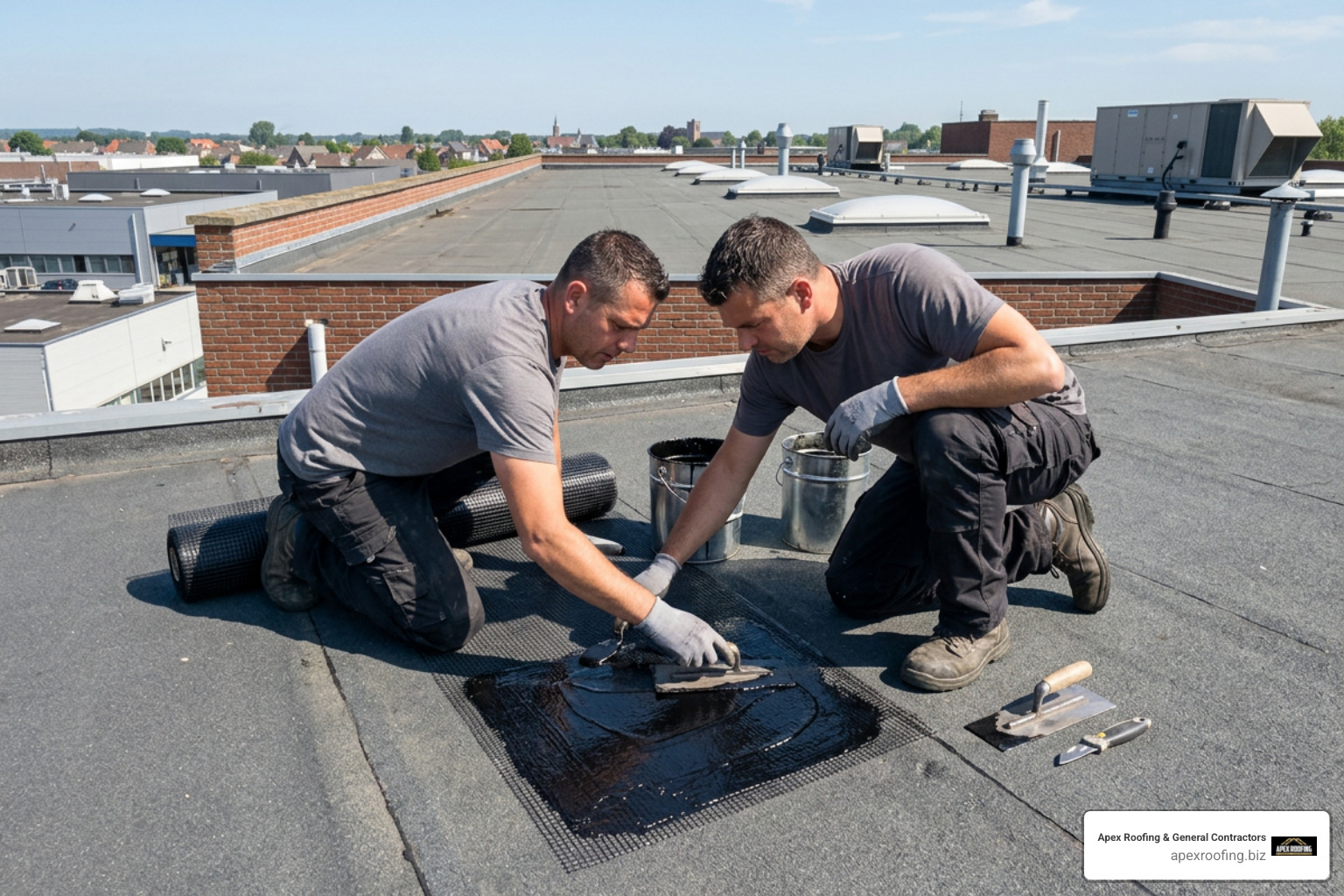
Commercial flat roof repair calls for systematic surface evaluation, moisture assessment, and precise compatibility checks before any patching method is selected. For broader background on specialized low-slope roof concerns, property managers can reference comprehensive technical guides such as this resource on how to repair a low pitch roof.
Commercial Materials and System Compatibility
Professional commercial roof repair technicians select ASTM-rated materials based on the existing roof system, manufacturer requirements, weather exposure, and local permit expectations. The correct repair approach for built-up roofing or modified bitumen can be very different from the correct approach for EPDM, TPO, or PVC. Using the wrong material can cause swelling, loss of adhesion, seam failure, or warranty problems.
Common professional considerations include:
- Reinforcement Fabrics: #30 asphalt-saturated felt paper, polyester reinforcement, or woven glass fiber scrim may be specified for dimensional stability across high-stress areas.
- Adhesives & Cold Mastics: ASTM D4586 asphalt plastic roof cement may be appropriate for compatible bitumen systems, while single-ply membranes require chemical-specific bonding products.
- Single-Ply Membrane Stock: TPO, PVC, and EPDM repairs must be matched to the existing membrane type, thickness, age, and manufacturer requirements.
- Primers & Cleaners: Non-aromatic solvent cleaners and membrane-specific primers are selected to address oxidation, surface contamination, and bonding requirements without damaging the roof.
- Precision Equipment: Certified crews use professional seam rollers, welding equipment where appropriate, moisture detection tools, and sealants designed for low-slope roof exposure.
Professional Restoration Quality Controls
When commercial roofing contractors restore localized roof damage, certified crews rely on quality-control checkpoints rather than guesswork. These checkpoints help confirm whether a roof is a candidate for localized patching or whether broader restoration or replacement is safer.

Key professional controls include:
- Substrate Condition Review: Crews verify whether the surrounding membrane is still sound, fully adhered, and free from widespread alligatoring, blistering, or seam delamination.
- Moisture Investigation: Wet polyisocyanurate insulation, wood fiberboard, or deteriorated decking must be identified because sealing over trapped moisture can cause vapor pressure, blistering, and recurring leaks.
- Compatibility Confirmation: Repair materials are matched to the existing roof membrane so that asphalt-based products, synthetic membranes, primers, and sealants do not chemically conflict.
- Reinforcement Assessment: High-movement areas, seams, penetrations, drains, and perimeter details are evaluated for reinforced repair methods that can tolerate thermal expansion and contraction.
- Drainage and Ponding Review: Low spots, clogged scuppers, blocked drains, and ponding water patterns are documented because standing water can shorten the life of any localized repair.
- Final Documentation: Professional roofers document repair areas, moisture findings, photos, and recommendations so property owners have records for maintenance planning, warranties, and Texas insurance claims.
A reinforced three-course repair may be recommended for compatible roof systems when the substrate is dry, stable, and structurally sound. For synthetic membrane standards, property managers can review technical guides on EPDM flat roof repair.
Property owners can also explore technical details regarding historical built-up roof restoration standards by reading about how to repair a flat roof with tar paper.
Evaluating Repair Options: Patching in Wet Conditions vs. Permanent Solutions
Roofing leaks frequently manifest during active Texas storm events. However, applying permanent adhesive patches during heavy rain is technically unfeasible for most roofing systems because water prevents solvent bonding, leading to immediate patch delamination.

When dealing with active rainfall, emergency response crews utilize temporary containment compounds:
- Granular Emergency Compounds: Non-toxic, clay-based granular repair products (such as Rapid Seal) can be poured directly into standing water or active leak sites. Covering roughly 40 sq ft per 25 lb pail at 0.5-inch thickness, these compounds swell to form a temporary plug, stopping interior water intrusion until dry weather allows permanent restoration. Once dry, the temporary material is swept away.
- ASTM D3409 Wet Patch Mastics: Rubberized asphalt wet patch cements (like Henry 208R) are formulated to adhere to wet or submerged surfaces during emergency situations. While effective for short-term containment, wet patches require roughly 30 days of cure time to release solvents before reflective topcoats can be applied.
For permanent repairs, commercial substrates must be 100% dry. Trapping moisture under a permanent patch creates vapor pressure under Texas heat, causing steam blisters and rapid bond failure. High-solids, moisture-cured silicone sealants are preferred for permanent repairs in low spots; once applied to a clean, dry surface, silicone cures rapidly and resists continuous standing water without emulsifying. Additional insights on emergency flat roof maintenance can be found in this guide on patch repair flat roof practical quick fixes.
Choosing Between Flat Roof Patching, Sealants, or Full Replacement
Determining whether a commercial flat roof requires localized patching, a liquid-applied restoration coating, or a complete tear-off depends on surface age, structural integrity, and building code thresholds.
A critical guideline across North America is the 25% Rule incorporated into building codes. Under local permit requirements, if more than 25% of a roof assembly’s surface area requires repair or recovery within a 12-month period, building codes mandate a complete roof replacement. Furthermore, extensive “alligatoring” (widespread surface cracking where bitumen has lost essential oils) or multiple soft spots in underlying wood decking indicate widespread system failure that localized patches cannot solve.
| Repair Option | Typical Lifespan | Coverage Area / Damage Scope | Average Cost Range | Primary Indication |
|---|---|---|---|---|
| Localized Membrane Patch | 3 to 7 Years | Small punctures, isolated seam failures (<5% of roof) | $6 to $18 per sq ft ($750 – $2,000 avg) | Mechanical damage, isolated punctures, tight budget |
| Liquid Silicone Coating | 10 to 20 Years | Entire roof surface with sound insulation (<15% wet) | $2.50 to $6.00 per sq ft | Aging roof, localized seam stress, UV degradation |
| Full Roof Replacement | 15 to 30+ Years | >25% damaged area, widespread wet insulation, structural rot | $9 to $18+ per sq ft ($5,000 – $15,000+ commercial) | Failed substrate, widespread alligatoring, code mandate |
Property managers navigating extensive building upgrades should review our comprehensive Commercial Roof Repair Guide 2026.
Patch Lifespan, Safety Precautions, and When to Call a Professional
A properly executed three-course reinforced patch typically lasts between 3 and 7 years, while standard non-reinforced felt patches last roughly 3 to 5 years. However, unshielded asphalt mastics deteriorate quickly under solar radiation. Applying a fibered aluminum reflective coating (which reflects over 70% of solar UV rays) or an elastomeric silicone topcoat significantly extends patch longevity by shielding raw bitumen from photo-oxidation.
Working on low-slope commercial roofs involves significant safety hazards. Property managers must prioritize fall prevention protocols:
- Fall Arrest Gear: Professional technicians utilize OSHA-compliant full-body harnesses, shock-absorbing lanyards, and secured perimeter tie-off anchor points whenever working near roof edges.
- Ladder & Perimeter Safety: Ladders must extend at least 3 feet above the roof landing edge and be secured at top and bottom. High-visibility perimeter warning lines are erected 6 feet back from edge boundaries.
- Protective Apparel: Technicians wear high-traction, oil-resistant footwear and heavy-duty nitrile gloves to shield skin from asphalt mastics and volatile solvent cleaners.
Self-executing roof repairs carry substantial financial and physical risks. DIY attempts frequently use incompatible materials—such as applying petroleum-based tar onto EPDM rubber, which triggers chemical molecular swelling that completely dissolves the rubber membrane. Furthermore, improper patching risks voiding existing commercial manufacturer warranties, misdiagnosing structural timber decay, and incurring severe Texas insurance claim denials due to unpermitted or non-compliant work.
When dealing with persistent leaks, sagging decking, widespread seam delamination, or complex HVAC flashing penetrations, hiring certified professional roofers ensures compliance with local permit requirements and building safety codes.
Frequently Asked Questions About Flat Roof Leak Repairs
How long does a DIY flat roof patch typically last?
A standard single-layer tar paper repair usually lasts between 3 and 5 years if protected with an aluminum reflective coating. A reinforced three-course “sandwich” patch (utilizing rubberized bitumen mastic embedded with fiberglass scrim mesh) lasts between 3 and 7 years depending on UV exposure, surface preparation, and structural roof movement.
Can I repair a flat roof during heavy rain or wet conditions?
Permanent roof patches require a completely dry substrate to achieve chemical adhesion. Attempting permanent patching during active rain will cause adhesive failure. However, emergency temporary repairs can be achieved during rainfall using specialized clay-based granular compounds that swell in standing water to form a temporary stopgap, or wet-patch asphalt mastics rated under ASTM D3409 standards. These temporary fixes must be replaced with permanent repairs once dry weather returns. Property owners dealing with severe felt roof damage can examine specialized advice on how to repair leaking flat felt roof.
What is the ‘three-course’ sandwich patching method?
The three-course patching method is a professional repair technique designed to absorb roof expansion and contraction without cracking. It involves three distinct layers: a base application of cold-applied bitumen mastic over the cleaned repair zone, a reinforcing layer of fiberglass mesh or polyester fabric fully embedded into the wet mastic to eliminate air pockets, and a final encapsulating topcoat of mastic that completely covers the fabric reinforcement.
This layered assembly acts like reinforced concrete, distributing thermal stress across the repair site. Because proper execution depends on precise material compatibility, correct substrate preparation, and professional moisture assessment, the three-course method should be performed by certified roofing technicians who can verify that the existing membrane, insulation, and decking are sound before sealing the repair. Improper application—particularly over trapped moisture or incompatible membranes—can accelerate deterioration rather than prevent it.
Conclusion: Protecting Your Building with Timely Maintenance
Proactive commercial flat roof maintenance costs up to 90% less than reactive structural repairs. Carrying out bi-annual inspections—specifically during spring and autumn—along with immediate post-storm assessments helps spot minor seam splits, clear clogged scuppers, and address ponding water before interior damage occurs.
For property owners across Central and South Texas, including San Antonio, Boerne, New Braunfels, Bulverde, and Alamo Heights, maintaining a watertight flat roof requires technical expertise, certified materials, and strict adherence to local building codes.
Protect your commercial investment and ensure total peace of mind by partnering with certified roofing professionals. Contact Apex Roofing & General Contractors today at (726) 727-7663 to request free estimates and schedule a free inspection.