How San Antonio-Area Inspectors and Roofers Identify Subtle and Hidden Hail Damage
To identify subtle and hidden hail damage, professional inspectors examine soft metal collateral, perform tactile shingle checks for bruised fiberglass matting, and chalk 10-foot by 10-foot test squares to count impact densities. Soft metals like aluminum gutters and air conditioning condenser fins show immediate indentations that reveal hail size and direction. On shingles, inspectors feel for soft, bruised spots where ceramic granules have loosened and the internal fiberglass mat has fractured beneath the surface. For professional roofers, hail damage evaluations help determine whether wind-driven impacts created hidden fractures across the roofing membrane. Apex Roofing & General Contractors provides certified, code-compliant local roofing services across San Antonio, Boerne, New Braunfels, Bulverde, and Alamo Heights, where spring hail, high winds, expansive clay soil movement, and intense San Antonio heat and UV load can turn small bruises into severe leaks.
To determine whether a home requires repair, roofing specialists look for specific ground-level indicators before performing an attic-to-ridge evaluation. Our standard guidelines to assess hail damage begin by examining soft metals around the property envelope. Soft metals include aluminum gutters, downspout elbows, copper chimney flashing, metal mailbox tops, exterior window screens, and the fragile cooling fins on outdoor air conditioning condenser units.
When hailstones strike these surfaces, they leave telltale dings, spatter marks, and indentations. Because air conditioning condenser fins and aluminum downspouts possess low structural density, they serve as reliable physical barometers for hail size and wind trajectory during a storm. If your AC fins are crushed or your gutters show impact dimples, the roof overhead took the exact same beating.
During an on-roof evaluation, professional inspectors map out 10-foot by 10-foot test squares (measuring 100 square feet) on each directional slope of the roof. Within each test square, the inspector circles every distinct hail impact using soft lumber chalk. Insurance adjusters require a specific density of strikes within these test squares – typically between 8 and 12 verifiable impacts per square – to authorize full slope or total roof replacement coverage.
Visual and Tactile Signs on Shingles, Wood, and Metal
Different roofing materials respond uniquely to the kinetic energy of hail impacts. Understanding what does hail damage look like on a roof requires distinguishing material-specific physical trauma from normal wear and tear:
- Asphalt and Composite Shingles: Impact points show up as dark, circular patches where protective ceramic granules have been dislodged, exposing the underlying black asphalt bitumen. Under tactile inspection, these impact sites feel soft and spongy – directly comparable to pressing your thumb into a bruised apple. This sponginess indicates that the internal woven fiberglass mat has fractured beneath the surface.
- Wood Shakes and Shingles: Hail impacts cause wood shakes to split along the grain. Fresh storm damage features clean, sharp-edged splits with an orange or light brown hue inside the crack. Older splits caused by thermal movement or natural drying exhibit weathered, dark gray interior edges with rounded margins.
- Metal Roofing Panels: Hail creates visible, concave indentations across metal seams and standing panels. While heavy gauge metal rarely punctures, these dimples can stretch the metal coating, trap water, compromise underlying fasteners, or break factory-applied weather seals.
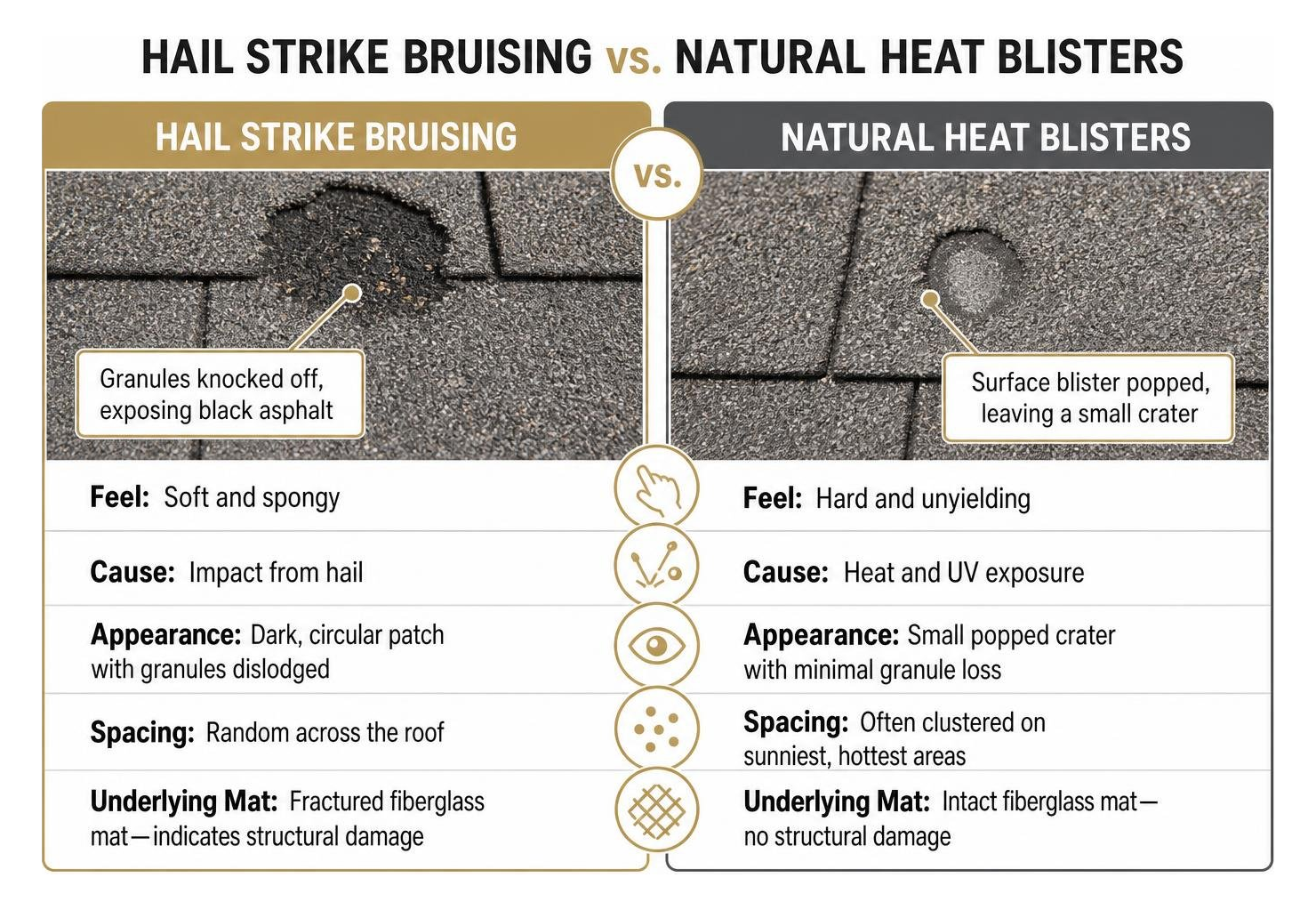
A critical component of this diagnostic process is separating genuine hail strikes from normal asphalt blistering. Shingles naturally release volatile organic gases as they bake under extreme heat and intense UV rays. When an unventilated roof overheats, these gases bubble to the surface and pop, creating tiny craters. Unlike true hail damage, a popped heat blister leaves a hard, unyielding base with no soft mat rupture beneath it. True hail damage exhibits random spacing and fractured internal backing.
How Professional Roofers Hail Damage Inspections Detect Hidden Fractures
Visual checks from a ladder only capture a fraction of post-storm trauma. When professional teams perform roofers hail damage inspections, they check for micro-fissures in the asphalt matting that compromise the home’s water-shedding barrier.
Hailstones strike roofs with substantial velocity, flexing the shingle downward. Even if the granule top coat appears mostly intact, this violent deflection can snap the fiberglass fibers within the shingle core. Once this internal skeletal layer breaks, thermal expansion during high-heat afternoons combined with nighttime cooling causes the shingle to expand and contract unevenly. This movement widens the hidden micro-fracture until water finds a direct pathway beneath the shingle course.
Professional assessments also analyze directional impact vectors. Hail driven by high straight-line winds strikes windward roof planes with greater force than leeward slopes. By documenting storm directionality and mapping impact densities across all exposures, a free storm damage roof inspection provides the clear evidence needed to ensure that no hidden damage is overlooked.
Why Time Matters: Risks of Delaying Hail Damage Roof Repairs
Postponing roof repairs after a severe storm invites costly structural deterioration. While a bruised shingle may keep water out during the first light drizzle following a weather event, unaddressed impacts steadily deteriorate until moisture breaches the underlayment, requiring professional storm damage roof repair to restore your home’s envelope.
Accelerated Weathering, Structural Leaks, and Water Damage Costs
The primary role of ceramic granules on asphalt shingles is protecting the underlying asphalt petroleum layer from ultraviolet radiation. When hail knocks those protective granules loose, raw asphalt is exposed directly to the sun.
Under sustained thermal loads, unshielded asphalt dries out, oxidizes, and shrinks. Within 6 to 18 months after hail impact, the bruised area hardens, develops spiderweb cracks, and tears completely open.
Once rainwater breaches the shingle mat and degrades the underlying felt, water enters the attic cavity. It saturates fiberglass insulation—destroying its R-value rating—and pools atop ceiling drywall, resulting in bubbling paint, brown stains, and sagging ceilings. If water damage from a storm is not addressed promptly, moisture migration can rot roof rafters, compromise ceiling joists, foster toxic mold colonies, and cause structural damage in excess of $20,000.
Insurance Policy Deadlines and Coverage Reclassifications
Waiting to address storm damage creates serious administrative risks with your insurance policy. Insurance carriers require policyholders to report property damage promptly following a covered event. In Texas, statutory insurance claim timelines and policy provisions typically require claims to be reported within one to two years of the date of loss.
If you delay calling your roofer and let the claim window close, two complications arise:
- Wear-and-Tear Reclassification: When an adjuster inspects a roof 14 months after a storm, the exposed asphalt has weathered significantly. Adjusters frequently deny these delayed claims, arguing that the roof’s failure stems from neglected maintenance, thermal cracking, or ordinary aging rather than a discrete weather event.
- Underwriting Cancellations and Non-Renewals: Insurance carriers routinely use high-resolution aerial imagery and drone scans during annual policy renewal reviews. If carrier imaging algorithms detect unaddressed storm damage, missing shingles, or weathered hail impact zones on your roof, the insurer may issue a formal notice of non-renewal or demand a mandatory, out-of-pocket roof replacement before renewing coverage.
The Insurance Claims Process: What Every Homeowner Must Know
Filing an insurance claim for hail damage does not have to be an overwhelming ordeal. Following our hail damage roof claim complete guide ensures that your property damage is thoroughly recorded, correctly calculated, and fully covered under your policy terms.
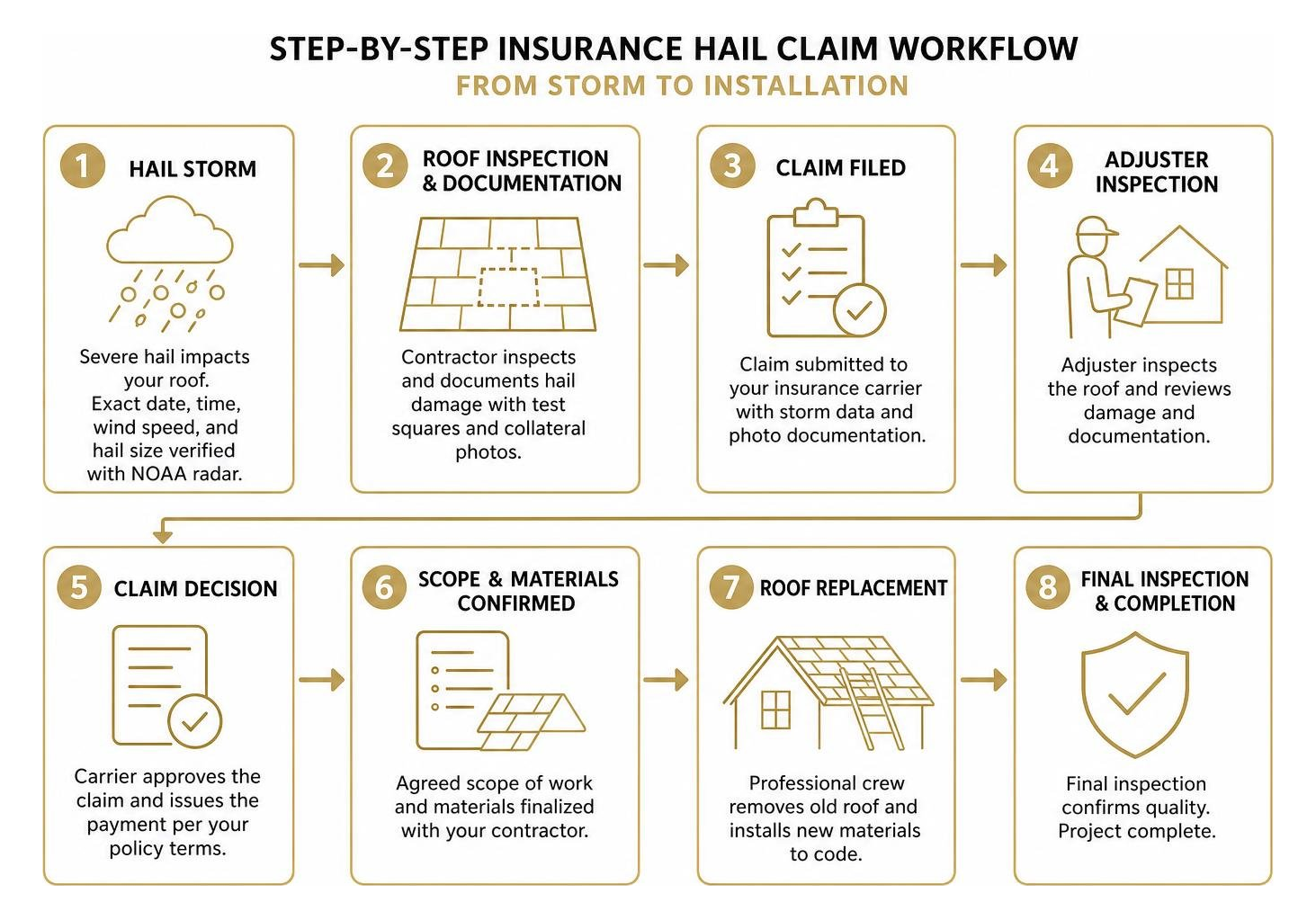
To build an air-tight claim, you need verified storm documentation. Professional contractors cross-reference your home’s exact coordinates with National Oceanic and Atmospheric Administration (NOAA) radar data to pinpoint the exact date, time, wind speed, and hailstone diameter that hit your property. Paired with date-stamped, high-resolution photos of test squares and collateral damage, this data provides the adjuster with objective proof of storm-created loss.
Replacement Cost Value vs. Actual Cash Value and Deductibles
Understanding how insurance carriers calculate payouts is critical to avoiding surprise out-of-pocket expenses. Most standard homeowner policies settle claims using one of two valuation frameworks:
| Feature | Actual Cash Value (ACV) | Replacement Cost Value (RCV) |
|---|---|---|
| Valuation Method | Current value minus age and depreciation | Full cost to replace at current market labor and material prices |
| Initial Payout | Depreciated value minus deductible | ACV amount issued first; depreciation released upon completion |
| Out-of-Pocket Expense | Deductible + all accumulated age depreciation | Only your policy deductible (subject to timely completion) |
| Completion Deadline | No repair timeline required (payout is final) | Usually 180 to 365 days to complete work and claim withheld funds |
With an RCV policy, the insurer issues a two-part payout. The first check covers the Actual Cash Value (the depreciated value of your current roof minus your deductible). Once an authorized roofer finishes the installation and submits a Certificate of Completion alongside the final invoice, the insurance company releases the “recoverable depreciation” check to cover the remaining balance. Most insurance carriers enforce a strict 180-day to 365-day completion window from the date of loss to release these depreciated funds.
Homeowners must also check their declarations page for separate wind and hail deductibles. Rather than a flat $1,000 deductible, many modern policies use percentage-based deductibles (typically 1% to 2% of the home’s total insured dwelling value). On a home insured for $400,000, a 2% hail deductible equals an $8,000 out-of-pocket expense before insurance coverage applies.
What Reliable Roofers Hail Damage Warranties Must Include
When selecting a contractor for storm repairs, verify that their estimate and project contract protect your long-term legal and financial interests:
- Supplemental Item Handling: Adjuster initial summaries routinely miss critical building code requirements, such as drip edge installation, ice and water shield membranes in valleys, and updated ridge ventilation. Your contractor should submit detailed photo-documented supplements directly to the insurance desk adjuster using industry-standard pricing software to ensure all required code components are covered.
- Cosmetic Damage Endorsement Navigation: Some modern policies include cosmetic damage exclusions that restrict coverage for aesthetic dents on metal panels if the roof still sheds water. A knowledgeable contractor identifies whether impacts have compromised functional seams, fasteners, or protective coatings to substantiate structural impairment.
- Appraisal Clause Guidance: If an insurance company underpays or denies a legitimate claim, your contractor can provide the comprehensive data package required if you choose to invoke your policy’s formal appraisal clause or engage independent dispute resolution mechanisms. Roofing contractors can provide objective damage documentation, but they do not act as licensed public adjusters or provide legal advice.
Why Hiring Experienced Roofers Hail Damage Experts Matters for Your Home
Severe weather events inevitably attract transient contractors looking for fast turnaround work. Property owners in San Antonio, Boerne, New Braunfels, Bulverde, and Alamo Heights can consult verified resources like the best 10 roofing near New Braunfels, TX directory to identify seasoned local specialists who understand regional requirements, such as expansive clay soils that shift foundations and pull on roof flashing, intense summer heat, spring hail patterns, high winds, San Antonio permit requirements, and municipal building codes.
Vetting Local Contractors and Avoiding Post-Storm Chaser Scams
Out-of-town storm chasers follow severe weather across the country, canvas neighborhoods with aggressive door-to-door sales tactics, throw up roofs using unsupervised sub-crews, collect final checks, and move on to the next storm zone. When workmanship leaks develop a year later, their phone numbers are disconnected, leaving homeowners with no warranty protection.
- Beware Deductible Absorption Schemes: If a contractor offers to waive, absorb, or pay your insurance deductible through promotional credits or advertising allowances, walk away immediately. In Texas and numerous other states, it is illegal for a roofing contractor to pay, waive, or rebate any portion of an insurance deductible. Engaging in this practice can constitute insurance fraud for both the contractor and the policyholder.
- Demand Proof of Local Presence: Require a physical commercial office address in your metropolitan area, a local phone prefix, active state registrations, and proof of comprehensive general liability and workers’ compensation insurance.
- Never Sign an Open Assignment of Benefits (AOB): Never sign documents transferring your total insurance policy rights over to a contractor before a fully detailed scope of work and price agreement have been established.
Contract Terms, Workmanship Warranties, and Impact-Resistant Upgrades
A reliable roofing contract clearly outlines all material specifications, tear-off depths, ventilation installations, clean-up processes, and warranty structures.
When scheduling a full roof replacement, you should consider upgrading to Class 4 impact-resistant shingles. To earn a Class 4 UL 2218 rating, a roofing material must withstand a 2-inch steel ball dropped twice from a height of 20 feet onto the exact same spot without cracking the internal matting or splitting the shingle. Upgrading to Class 4 materials not only hardens your home against severe storms, but it can also qualify you for annual homeowner insurance premium discounts of up to 20% to 30%, depending on your carrier. For Bulverde-area service, property owners can consult our dedicated roofers near Bulverde team to review regional installation requirements.
Frequently Asked Questions About Storm and Hail Damage
What hail size causes roof damage?
The physical impact threshold for roof damage depends directly on the age, structural design, and composition of your roofing material. Reviewing what hail size causes roof damage highlights these key structural thresholds:
- Dime-Sized Hail (3/4 Inch): Hail must generally be larger than 3/4 inch in diameter to cause damage to deteriorated, brittle, or aging composite shingles.
- Quarter-Sized Hail (1 Inch): Lightweight composite shingles and standard architectural shingles will show clear granule loss, circular bruising, and soft metal dents after being struck by 1-inch diameter hail.
- Half-Dollar Sized Hail (1 1/4 Inches): Hail must reach at least 1 1/4 inches in diameter to crack heavy composite shingles, fracture solid cedar wood shakes, or dent heavy-gauge metal flashing.
- Egg to Baseball-Sized Hail (2 to 2 3/4 Inches+): Severe hailstones of this magnitude easily puncture roof underlayment, split heavy structural decking, and destroy roof vents, requiring immediate emergency intervention.
What is a cosmetic damage exclusion in my insurance policy?
A cosmetic damage exclusion is a specific endorsement attached to certain property insurance policies that eliminates claim payouts for storm impacts that alter a roof’s visual appearance without compromising its water-shedding performance. These endorsements are most commonly attached to policies covering metal roofs and impact-resistant shingle systems.
If hail creates dimples in metal panels or scuffs an impact-resistant shingle, but the underlying seams, fasteners, and waterproofing integrity remain functional, an insurer enforcing a cosmetic exclusion will deny the replacement claim. Homeowners should review their policy declarations page to verify whether this endorsement is present on their policy.
What should I do if my insurance adjuster denies or underpays my claim?
If an insurance adjuster denies your claim or provides an estimate that fails to cover the full cost of repairs, take the following steps:
- Request a Detailed Line-Item Breakdown: Obtain the adjuster’s complete itemized scope of work to identify which building components, code items, or slopes were omitted.
- Schedule a Joint Contractor Re-Inspection: Have your roofing contractor compile a detailed photographic report—including test-square counts, NOAA meteorological records, and collateral metal damage photos—and request that the insurer send a different adjuster for a secondary joint inspection.
- Submit a Formal Supplement: If the discrepancy involves omitted materials, local building code requirements, or manufacturer installation mandates, have your contractor submit a detailed supplemental claim with photographic proof.
- Invoke the Policy Appraisal Clause: If you reach an irreconcilable pricing stalemate with your insurer, you can exercise the appraisal clause in your policy. This process appoints an independent, neutral umpire to evaluate the structural damage and make a legally binding loss determination.
Conclusion
Prompt storm response, meticulous physical documentation, and working with an experienced, certified contractor are essential steps to protecting your home after severe weather in San Antonio, Boerne, New Braunfels, Bulverde, and Alamo Heights. Overlooked shingle bruising accelerates weathering and leads to interior water leaks, mold growth, and denied Texas insurance claims down the road.
For property owners throughout the local service area, our dedicated team provides expert evaluations, clear communication, and dependable restoration through our specialized hail damage roof repair in San Antonio services. Contact Apex Roofing & General Contractors today at (726) 727-7663 for free estimates and to schedule your free inspection before minor storm impacts turn into major structural repairs.