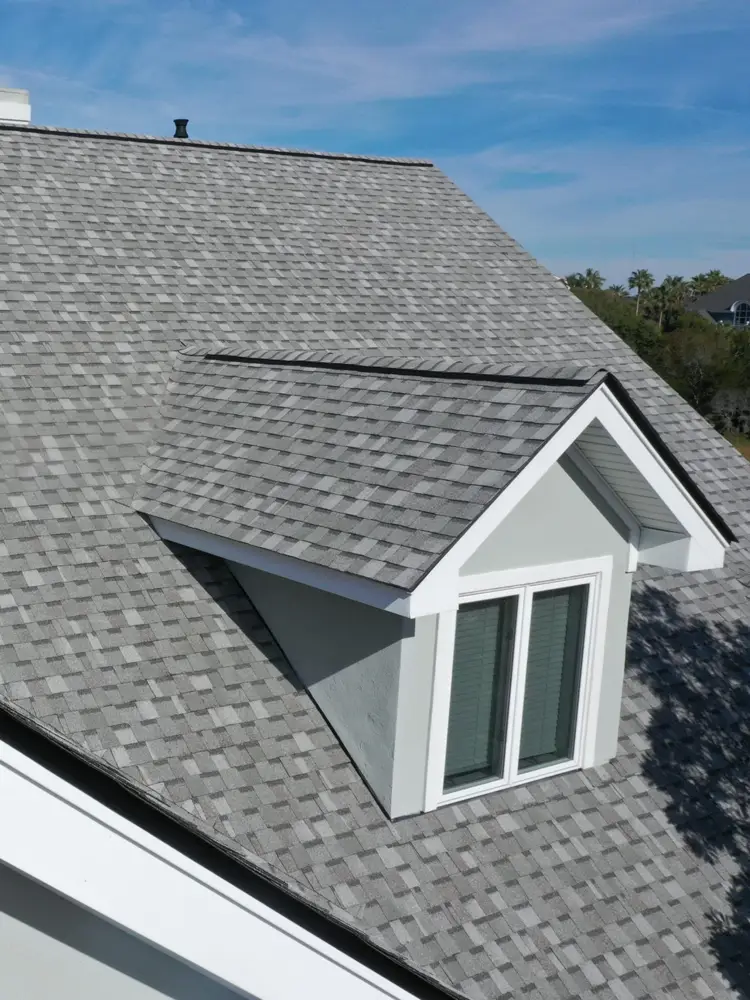
Free Roof Replacement Options for San Antonio-Area Homeowners
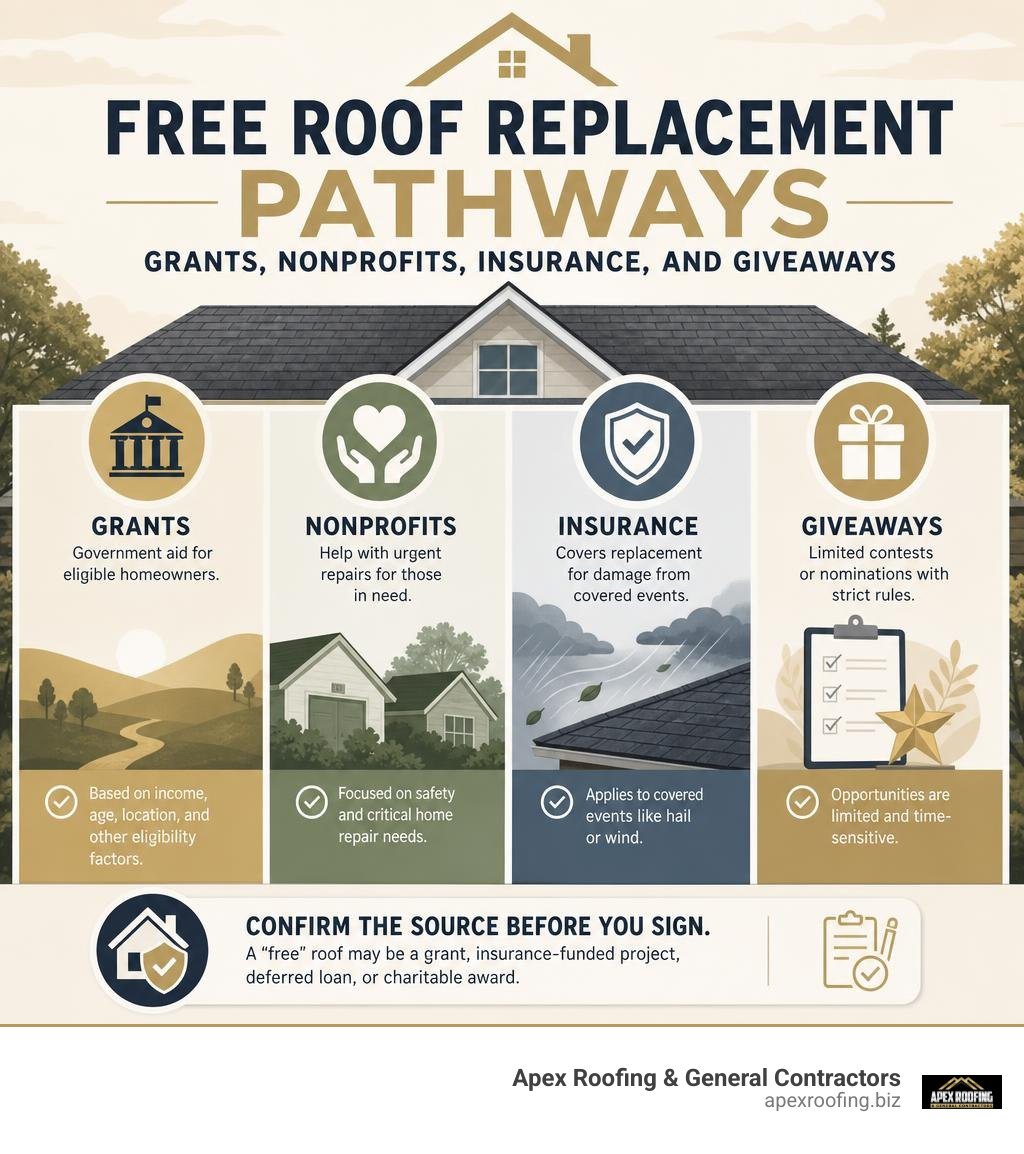
Free roof replacement is available to some homeowners through government grants, nonprofit repair programs, insurance claims for covered storm damage, and limited roofing-company giveaways. It is not one single program, and eligibility usually depends on your income, age, homeownership status, location, roof condition, and the cause of the damage.
- Government aid: May help low-income, senior, rural, or disaster-affected homeowners pay for essential repairs.
- Nonprofits: May provide free or reduced-cost work for households with urgent safety needs.
- Insurance: Can pay for a replacement when a covered event, such as hail or wind, damages the roof.
- Giveaways: Are limited contests or nomination programs with strict rules and deadlines.
For clear guidance on roof condition, storm damage, and practical next steps, trusted roofing guidance for San Antonio-area homeowners can help you understand what to check before making decisions. The key is to confirm the source of funding before signing a contract: a “free” roof may be a grant, an insurance-funded project, a deferred loan, or a charitable award.
I am Carlos Yzaguirre, President and Managing Partner of Apex Roofing & General Contractors, serving Texas homeowners with roof repair, replacement, and storm-damage solutions since co-founding the company in 2022. My experience helps homeowners separate legitimate free roof replacement paths from unclear offers and understand what their roof actually needs.
Must-know free roof replacement terms:
- Free roofing estimates San Antonio
- New roof cost San Antonio
- Roof storm damage San Antonio
Government Aid Programs for Free Roof Replacement
Government financial assistance for roof replacement comes through federal, state, and municipal programs designed to eliminate health hazards, preserve housing stock, and help qualifying households recover from disasters. Homeowners facing severe structural deterioration can access targeted grants, zero-interest deferred loans, or low-interest rehabilitation loans through agencies like the United States Department of Agriculture (USDA) and the Department of Housing and Urban Development (HUD).
Federal programs focus primarily on very-low-income homeowners, elderly residents, and individuals living in designated rural areas or disaster locations. For instance, federal grant allocations under rural development rules provide grant funding up to $10,000 for homeowners aged 62 and older to clear critical safety hazards. When a home is located within a presidentially declared disaster zone, maximum emergency grant caps increase up to $15,000.
In addition to outright grants, government programs often offer low-cost financing options, such as 1% fixed-rate loans with repayment terms extending up to 20 years. Homeowners living in areas with high summer heat benefit significantly from specialized municipal and federal weatherization efforts. Municipal initiatives like Under 1 Roof: Cool Roofs for High-Heat Areas help qualifying homeowners install solar-reflective materials that mitigate extreme UV loads while preserving structural health. When property damage stems directly from severe Texas windstorms or hail events, homeowners frequently pair municipal aid guidance with professional Storm Damage Roof Replacement services to navigate federal and regional recovery funds.
USDA Section 504 Eligibility and Application Steps
The USDA Section 504 Single Family Housing Repair program provides direct grants and 1% fixed-rate loans to very-low-income rural homeowners to repair, modernize, or eliminate safety hazards in their homes. To qualify for a Section 504 grant, applicants must be at least 62 years old, own and occupy the home as their primary residence, be unable to obtain affordable credit elsewhere, and fall below the established county low-income threshold (typically 50% of the Area Median Income).
For younger low-income homeowners who do not meet the age requirement for grants, Section 504 offers repair loans up to $40,000 at a fixed 1% interest rate over a 20-year term. Homeowners seeking assistance must submit Form RD 3550-35 (Intake Form) along with income verification, tax documents, and property deeds to their regional USDA Rural Development office.
Local Government Grants and Municipal Emergency Repairs
Municipal housing departments administer local emergency repair initiatives funded by federal block grants and the American Rescue Plan Act (ARPA). Programs such as local Basic Systems Repair assist owner-occupied single-family homes experiencing immediate health or habitability emergencies.
To qualify for emergency municipal roof work, cities often establish specific physical damage thresholds, such as requiring an active leak that has caused an interior ceiling collapse of at least 4 square feet in a heated living space. Applicants must be current on local property taxes or enrolled in an active payment agreement, occupy the residence as their sole real estate property, and meet income limits that scale with household size (often capping around $85,900 for a single occupant).
Nonprofit Organizations and Community Assistance
Nonprofit housing organizations provide vital relief to low-income families, elderly residents, and disabled homeowners who require critical roof repairs but lack financial resources or commercial credit access. Nonprofits operate through charitable donations, volunteer labor networks, corporate sponsorship, and federal housing preservation grants to deliver zero-cost or deeply discounted roof work.
Programs like Habitat for Humanity’s Home Preservation initiative and “A Brush with Kindness” focus on keeping low-income families in safe, dry homes through exterior repairs, weatherization, and structural stabilization. Nonprofits frequently utilize a revolving fund model, where minor loan repayments from assisted homeowners are reinvested locally to fund repairs for neighboring families. Specialty organizations, including SeniorStrong, focus exclusively on helping senior citizens age in place safely by removing urgent roofing hazards.
Homeowners searching for financial relief options can review our comprehensive Affordable Roofing San Antonio Guide to evaluate how community preservation resources integrate with local contractor solutions.
Free Roof Replacement for Seniors and Veterans
Charitable programs prioritize senior citizens aged 62 and above, disabled residents, and military veterans due to their fixed incomes and vulnerable living situations. Organizations partnering with regional veteran support networks often waive equity requirements and provide 100% grant-funded materials and labor. Assistance models frequently incorporate “sweat equity,” allowing healthy family members or community volunteers to assist on-site to minimize overall overhead costs and extend grant funding to more households.
Local Non-Profit Roof Repair Resources
Local housing authorities, community action agencies, and regional non-profit housing networks offer emergency repair grants to address structural roof failure. Homeowners residing in nearby communities like Boerne can explore regional housing support channels, ask whether participating contractors are licensed and insured, and request written documentation before approving any roof repair or replacement work.
Contractor Giveaways and Community Review Grants
Local roofing contractors frequently host charitable community giveaways and review-based pledge programs designed to gift a free roof replacement to deserving local families in financial distress. These initiatives reward community support while directly helping homeowners who cannot afford emergency repairs.
Under review-milestone models, contractors pledge to install one free residential roof for every 100 five-star Google or customer reviews received. Giveaway programs usually establish strict structural boundaries, capping eligible roofs at 2,000 square feet (or 30 squares of roofing material) and specifying standard 50-year architectural shingles. To prevent misuse, applicants must demonstrate primary residence ownership for at least five consecutive years, occupy a 1-to-2 story single-family structure, and provide proof of genuine financial hardship.
Homeowners interested in evaluating local contract pricing or promotional program eligibility can request a formal Free Roof Replacement Estimate to assess their home’s dimensions and structural needs.
How Roofing Company Giveaways Work
Roofing giveaways utilize nomination forms where neighbors, friends, or family members submit detailed stories highlighting a nominee’s community contributions, veteran status, or medical hardships. Selectors review written nominations, conduct photo verification of the roof’s current condition, and verify property ownership before awarding the installation package.
Navigating Insurance Claims vs Free Roof Options
Many homeowners confuse insurance-funded roof installations with zero-cost giveaways or government grants. When a roof sustains severe damage from spring hail, high winds, or severe Texas severe weather events, your property insurance policy may cover the complete cost of replacement minus your policy deductible.
Understanding insurance terminology prevents misunderstandings regarding out-of-pocket responsibilities. A deductible is a contractually required policyholder contribution that cannot legally be waived or absorbed by a roofing contractor under Texas law.
To determine whether your roof damage qualifies for a full claim, homeowners should read our guides on Does Homeowners Insurance Cover a New Roof and review How to File a Roofing Claim Without Losing Your Mind before interacting with insurance adjusters.
Qualifying for Assistance: Requirements and Timelines
Qualifying for government grants, non-profit aid, or municipal home rehabilitation requires careful documentation and adherence to rigid processing schedules. Because funds are strictly allocated based on verified financial need and structural risk, applicants must supply detailed records upfront to avoid processing delays.
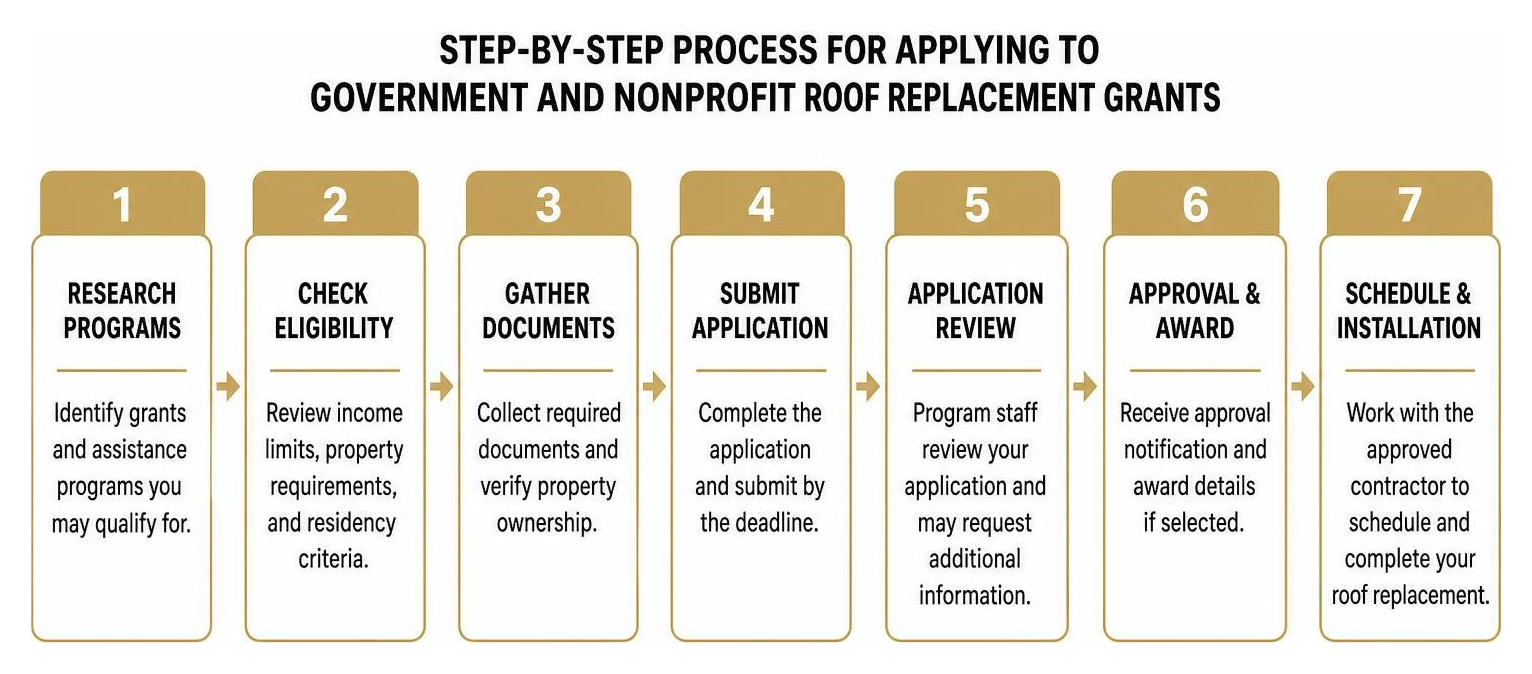
Program processing timelines vary depending on the funding source and local application backlog. Emergency municipal triage programs addressing active ceiling collapses can process approvals within a few business days, whereas federal USDA Section 504 loans and grants typically require 30 to 90 days for thorough review and contractor bid approvals.
| Assistance Program | Primary Eligibility Target | Maximum Grant Amount | Loan Terms Available | Key Documentation Required |
|---|---|---|---|---|
| USDA Section 504 | Rural seniors (Age 62+) & very-low income | Up to $10,000 ($15,000 in disaster zones) | 1% fixed rate over 20 years ($40k max) | Form RD 3550-35, tax returns, deed |
| Municipal Emergency Repair | Owner-occupants with active severe leaks | Direct repair / 100% grant | Deferred payment loans available | Proof of income, current property tax status |
| Non-Profit Preservation | Low-income, disabled, veterans, seniors | Direct repair / Sweat equity | Revolving zero-interest micro-loans | ID, income proof, hardship statement |
| Contractor Giveaways | Local families facing severe hardship | Full replacement (Up to 30 squares) | None (100% gift to selected winner) | Nomination essay, photos, ownership proof |
Document Checklist for Free Roof Replacement Applications
When preparing an application for government grants or charitable roof assistance, gather the following verified documentation:
- Valid government-issued photo identification for all adult household residents
- Recorded deed of trust or property ownership documentation proving primary residency
- Recent municipal property tax statements demonstrating good standing or active payment agreements
- Proof of household income (three consecutive years of federal tax returns, recent pay stubs, or annual Social Security benefit statements)
- Current utility statements matching the applicant’s name and property address
- Clear photographic evidence detailing active interior leaks, ceiling damage, or structural roof decay
- Official written estimates provided by licensed, local roofing contractors
Program Processing Durations and Application Steps
The application process follows a structured sequence:
- Prequalification: Verify property eligibility via regional USDA eligibility maps or municipal income limit charts.
- Document Assembly: Gather tax returns, property deeds, and contractor estimates.
- Application Submission: Submit formal paperwork online or through local housing authority intake staff.
- Site Inspection: A program representative inspects the roof to confirm habitability hazards or code violations.
- Contractor Bidding & Award: Grant funds are allocated, and licensed contractors complete the work under direct agency oversight.
Frequently Asked Questions About Roof Repair Assistance
What qualifies as an emergency for free roof replacement?
An emergency qualification generally requires an active structural hazard that poses an immediate threat to human safety or property habitability. Under municipal guidelines, this frequently means severe storm damage resulting in an active roof leak that has caused an interior ceiling collapse measuring at least 4 square feet in a heated living room or bedroom. Minor single-shingle shifts or cosmetic wear are classified as routine maintenance and do not qualify for emergency grant triage.
What are the income limits for roof repair assistance programs?
Income limits are defined by local Area Median Income (AMI) thresholds established annually by HUD and the USDA. Most federal repair grants require household earnings to fall below 50% of the county AMI, categorizing the applicant as “very low income.” Municipal programs, such as city-funded emergency repair initiatives, establish tiered brackets scaling with family size, often allowing single-person households earning up to $85,900 to qualify depending on specific regional guidelines.
How long does the application process take for roof grants?
The application duration ranges from two weeks to three months depending on the agency and emergency classification. Municipal emergency programs addressing structural collapse prioritize rapid intake within 10 to 14 days. Federal programs like USDA Section 504 generally take 30 to 90 days from initial Form RD 3550-35 submission through final environmental review, contractor verification, and grant approval.
Conclusion
Understanding your path to a free roof replacement comes down to separating legitimate government grants, charitable giveaways, and insurance claim proceeds from ambiguous promotional claims. Low-income homeowners, rural residents, and seniors can secure financial relief through federal USDA Section 504 grants, municipal ARPA repair programs, and non-profit initiatives like Habitat for Humanity. Meanwhile, policyholders experiencing sudden spring hail or high winds can leverage Texas insurance claims to fund structural restoration while adhering to local permit requirements.
Local property owners dealing with severe San Antonio heat/UV load, expansive clay soils, or sudden weather impacts require trustworthy guidance to safeguard their investments. To examine your roof’s current health, verify damage, and receive honest technical guidance, contact Apex Roofing & General Contractors today for free estimates or call (726) 727-7663 for a free inspection. For complete details on full system updates, explore our guide on Roof Replacement San Antonio.