- Locations
- San Antonio
- Storm Damage Roof Repair
Storm & Hail Damage Roof Repair in San Antonio, TX
Summary
Apex Roofing & General Contractors provides licensed storm damage roof repair in San Antonio, TX, covering hail damage, wind damage, and debris impact for homes and businesses. Costs range $300 to $20,000 depending on severity. The team documents damage for insurance claims and offers emergency response within days.
Key Takeaways
- Apex Roofing & General Contractors provides storm damage roof repair in San Antonio, TX for residential and commercial properties.
- Services cover hail damage repair, wind damage repair, debris impact repair, flashing repair, and gutter and drainage repair.
- Storm damage repair costs typically range from $300 to $4,000, while a full storm-related roof replacement ranges from $7,000 to $20,000.
- The team documents damage with drone imaging and detailed photo reports to support insurance claims with adjusters.
- Class 4 impact-resistant shingles are recommended for homeowners in hail-prone areas, and may qualify for insurance premium discounts.
- Emergency tarping and temporary stabilization are provided for active leaks before full repairs begin.
- Free storm damage inspections and financing options are available.


Storm Damage Roof Repair

San Antonio’s mix of spring hailstorms, straight-line winds, and the occasional remnants of Gulf hurricanes puts local roofs through more stress than most homeowners realize, often until a leak shows up on the ceiling. Apex Roofing & General Contractors provides fast, reliable storm damage roof repair in San Antonio, built around three priorities: rapid response when a roof is actively leaking, an honest inspection that separates cosmetic wear from real structural risk, and a repair plan that aligns with what your insurance carrier will actually cover.
As a licensed San Antonio roofing contractor, we know that hail and wind damage isn’t always visible from the ground. Our team inspects thoroughly, documents everything with detailed photos and reports, and works directly with adjusters to help you get the coverage you’re entitled to, without pushing unnecessary repairs or leaving damage unaddressed until it becomes a bigger problem.
What Causes Storm Damage to San Antonio Roofs
Bexar County sits in a corridor that regularly sees severe thunderstorms carrying large hail, and San Antonio’s summer and fall exposure to tropical weather adds sustained high winds to the mix – the National Weather Service Austin/San Antonio office issues the severe thunderstorm and hail warnings for Bexar County and posts local storm reports after each event. Hail bruises and fractures asphalt shingle granules, which is why a roof can look intact from the ground but still be losing its ability to shed water. Straight-line winds lift shingle edges and tear back flashing around chimneys, vents, and skylights, creating entry points for water long before a homeowner notices a stain indoors.
Falling limbs and debris punch through decking directly, and prolonged wind-driven rain finds its way into any gap that’s already been weakened by UV exposure or age. For a deeper look at how these forces affect roofing materials generally, the Insurance Institute for Business & Home Safety publishes independent research on wind and hail performance standards that homeowners and adjusters both reference.
Types of Storm Damage We Repair in San Antonio, TX
Not all storm damage looks the same, and each type requires a different repair approach. Here’s what our team commonly identifies and fixes on San Antonio roofs after severe weather.
Hail Damage
Hail bruises and cracks shingles, knocks off protective granules, and can dent metal roofing panels, gutters, and vents. Damage is often scattered and easy to miss from the ground, which is why a close inspection matters even when a roof looks intact after a hailstorm. Left unaddressed, bruised shingles lose their ability to shed water properly and tend to fail well before their expected lifespan. Our team checks slopes, valleys, and metal components individually, since hail impact rarely affects a roof evenly.
Wind Damage
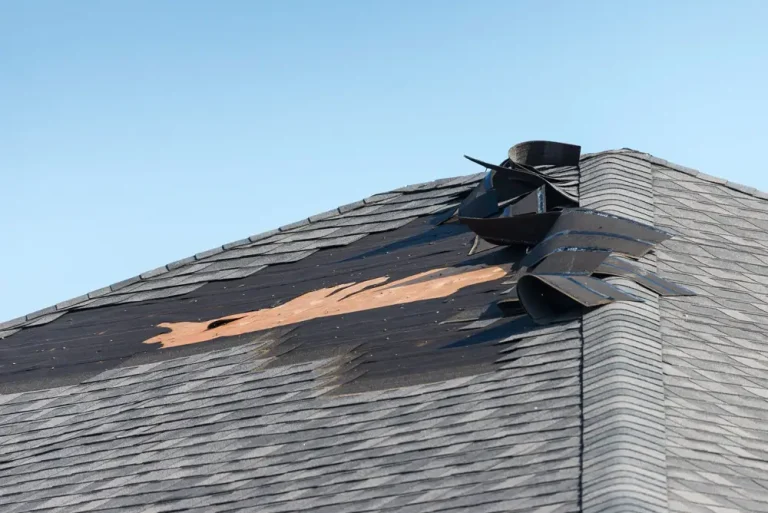
Strong winds lift and loosen shingle edges, tear off ridge caps, and can peel back entire sections of roofing in severe cases. Once a shingle seal is broken, water finds its way underneath with the next rain, even if nothing looks visibly torn. Wind damage tends to concentrate along roof edges, ridges, and corners, where uplift pressure is strongest during a storm. We inspect these high-risk areas closely, since a single lifted shingle can compromise the section around it if left unrepaired.
Wind-Driven Rain and Water Intrusion
Heavy, wind-driven rain can push water under shingles, through damaged flashing, and into areas a roof normally sheds water away from. This often shows up as ceiling stains or attic leaks days after the storm has passed. Because this type of damage isn’t always tied to visible roof damage, homeowners are sometimes surprised to learn a storm caused it. We trace the water’s path back to its true entry point rather than just addressing where it appears indoors.
Debris Impact
Fallen tree limbs, flying debris, and airborne objects during high winds can puncture roofing material, crack decking, or dislodge sections of the roof entirely, requiring immediate attention to prevent further water intrusion. These punctures create a direct path for water into the home, so we treat them as priority repairs whenever possible. In more severe cases, damaged decking beneath the puncture also needs to be assessed and reinforced before new roofing material goes down.
Flashing and Seal Damage
Flashing around chimneys, vents, and skylights is especially vulnerable during storms, as wind and impact can loosen or crack seals that were previously watertight, creating a common but often overlooked leak source. Because flashing sits at transition points on the roof, even small gaps here can lead to leaks disproportionate to the size of the damage. We reseal or replace affected flashing using materials that match manufacturer specifications to protect any existing warranty.
Gutter and Drainage Damage
Hail and debris frequently dent, crack, or detach gutters and downspouts, which affects how well water drains away from the roofline and foundation, sometimes leading to secondary damage if left unaddressed. Poor drainage after a storm can also cause water to pool near the roofline, increasing the risk of leaks at the roof’s edge. We inspect gutters as part of every storm damage assessment, since drainage issues are often connected to the roofing damage itself.
If your roof has experienced any of these issues, our team can inspect the full extent of the damage and recommend the right repair, backed by documentation to support your insurance claim if needed.
San Antonio Hail Size and Roof Damage Severity Guide
Not every hailstorm damages a roof the same way, and hail size is one of the clearest predictors of how serious that damage is likely to be. The table below reflects what our inspectors typically find on San Antonio roofs after a hailstorm, matched to the recommended next step.
Hail Size | Typical Roof Damage in San Antonio | Recommended Action |
Pea-sized (¼”) | Minimal to no impact; light granule disturbance | Monitor; no action usually needed |
Marble-sized (½”) | Noticeable granule loss, early shingle bruising | Free inspection recommended |
Quarter-sized (1″) | Cracked or bruised shingles, exposed asphalt mat | Repair typically needed |
Golf ball-sized (1.75″) | Punctured shingles, dented flashing and gutters | Repair or partial replacement likely |
Baseball-sized (2.75″+) | Widespread shingle failure, damaged decking | Full roof replacement often required |
If a recent storm in your area matches the golf ball-sized range or larger, it’s worth scheduling a free roof inspection in San Antonio even if you don’t see obvious damage from the ground.
Signs You Need Storm Damage Roof Repair in San Antonio TX
Storm damage isn’t always obvious from the ground, and even a roof that looks fine after a storm can hide real issues underneath. Here are the key warning signs it’s time to have your roof professionally inspected.
- Granule loss in gutters or downspouts: A sign hail has stripped the protective coating off your shingles, even if the roof looks fine from the driveway.
- Soft or spongy spots underfoot: Usually decking that has already absorbed water and started to weaken.
- Bruised or dented shingles: Hail impact marks that compromise the shingle’s waterproofing even without visible cracking.
- Lifted or missing shingles after a windstorm: An open seam that lets water track under the roofline during the next rain.
- Bent, creased, or missing flashing: Around chimneys, vents, and skylights, one of the most common leak points our roof inspection team finds after a storm.
- Water stains on ceilings or attic insulation: A clear sign water has already made it past the roof deck and needs prompt attention.
- Visible daylight through the attic roofline: An urgent sign that calls for our emergency roofing response rather than a scheduled inspection.
If any of these sound familiar, it’s worth getting ahead of it. Left alone, storm damage rarely stays cosmetic, a small granule loss issue this season becomes a decking replacement next season, and a small leak becomes drywall and insulation damage that costs far more than the roof repair itself.
Roof Repair vs. Roof Replacement After Storm Damage
Deciding between a repair and a full San Antonio roof replacement after a storm comes down to a few consistent factors, and our inspection is built to walk you through each one honestly rather than defaulting to the larger job.
Factor | Repair Usually Works | Replacement Usually Needed |
Damage extent | Isolated damage to a few shingles or one slope | Widespread damage across most of the roof |
Roof age | Roof is under 10–12 years old | Roof is already near or past its expected lifespan |
Decking condition | Decking is intact, no rot or delamination | Decking is soft, delaminated, or water-damaged |
Insurance scope | Adjuster approves a spot repair | Adjuster approves full replacement due to damage scope |
Future leak risk | Low risk of recurring leaks after a targeted repair | High risk of repeat leaks without a full roof replacement |
When the answer isn’t clear-cut, we’ll show you exactly which factors are driving the recommendation rather than just quoting one option. If replacement is the answer, the City of San Antonio requires a re-roof permit pulled by a registered contractor (City of San Antonio Development Services – Residential Permits); we handle that as part of the job.
Storm Damage Roof Repair and Your Insurance Claim
Filing a storm damage claim can feel overwhelming, especially when you’re not sure what qualifies for coverage or how thorough your documentation needs to be. Apex Roofing & General Contractors works directly with homeowners, property managers, and insurance adjusters throughout the San Antonio roof insurance claims process, from the initial inspection to the final repair, so you’re not navigating it alone.
Our team documents every part of the damage with detailed photos, drone imaging where needed, and written reports that clearly outline what caused the damage and what it will take to fix it. According to the Insurance Information Institute, hail alone causes billions of dollars in insured losses across the U.S. each year, with Texas consistently ranking among the states hit hardest, which is part of why thorough documentation matters so much when filing a San Antonio storm damage claim. Whether your roof needs a targeted San Antonio roof repair or a full replacement, we make sure the scope of work we recommend matches what the damage actually requires, not what pads a claim unnecessarily.
Why Choose Apex Roofing & General Contractors in San Antonio
- Local Storm Expertise: Based in San Antonio, we understand how hail, wind, and Gulf-driven storms uniquely affect roofs in this region.
- Licensed and Insured: Fully licensed, bonded, and insured for residential and commercial storm damage repair, giving property owners confidence in every job.
- Rapid Response: Our emergency roofing team responds quickly to stabilize active leaks and exposed sections before further damage occurs.
- Thorough Damage Documentation: We use drone imaging and detailed photo reports to capture the full scope of hail, wind, and storm damage, even what isn’t visible from the ground.
- Insurance Claim Support: We work directly with adjusters throughout the insurance claim process, helping you get the coverage you’re entitled to without navigating the paperwork alone.
- Manufacturer-Compliant Repairs: All repairs follow manufacturer specifications to help preserve existing roofing warranties wherever possible.
- Flexible Financing Options: For repairs not fully covered by insurance, we offer financing options so unexpected storm damage doesn’t have to be a financial burden.
- Recognized Craftsmanship: Our work has earned industry recognition and awards for quality and customer satisfaction across San Antonio.
Impact-Resistant Shingle Upgrades for San Antonio Homes
For homeowners who’ve dealt with repeated hail damage, upgrading to impact-resistant shingles during a repair or replacement can significantly reduce future storm-related issues. These shingles are engineered with reinforced mats and materials designed to absorb hail impact without cracking, splitting, or losing their protective granules the way standard shingles often do.
Impact-resistant shingles are rated using the UL 2218 Class 4 rating, the highest impact-resistance classification available, and are tested to withstand repeated hits from steel balls simulating large hail. Many insurance carriers offer premium discounts for homes with Class 4 shingles installed, since they’re statistically less likely to require storm damage claims. For San Antonio homeowners who’ve filed more than one hail-related claim, this upgrade is often one of the most practical long-term investments available during a roof repair or replacement.
Storm Damage Roof Repair Cost Estimates for San Antonio, TX
Storm damage repair costs vary based on the extent of the damage, the material affected, and whether the issue is isolated or spread across the roof. The table below provides general pricing ranges to help you plan before scheduling an inspection.
Type of Storm Damage | Typical Repair Cost Range | Notes |
Isolated hail damage (few shingles) | $300 – $800 | Spot repair, matching shingles used |
Widespread hail damage (full slope) | $1,500 – $4,000 | May require partial or full section replacement |
Wind-lifted or missing shingles | $400 – $1,200 | Depends on number of shingles affected |
Flashing or seal repair | $250 – $700 | Common around chimneys, vents, and skylights |
Gutter and downspout repair/replacement | $300 – $1,000 | Varies by length and extent of damage |
Decking repair (storm puncture) | $500 – $1,800 | Cost increases with size of damaged area |
Emergency tarping/temporary repair | $200 – $600 | Applied to stabilize damage before full repair |
Full storm-related roof replacement | $7,000 – $20,000 | Recommended when damage covers 30%+ of the roof |
These figures reflect general San Antonio market ranges and aren’t a final quote. Actual costs depend on your roof’s size, material, and damage extent. Covered storm damage may be reimbursed through your insurance claim. For an accurate estimate, request a free inspection from Apex Roofing & General Contractors.
Our Storm Damage Roof Repair Process for San Antonio, TX Properties
Every storm damage repair follows a clear, structured process to make sure damage is fully identified, properly documented, and repaired the right way the first time.
- Emergency Response (if needed): For active leaks or exposed sections after a storm, we prioritize fast tarping or temporary stabilization to prevent further water intrusion while a full repair is scheduled.
- Thorough Storm Damage Inspection: Our san antonio roof inspection team examines every slope, valley, and penetration point, using drone imaging to catch damage that isn’t visible from the ground.
- Detailed Documentation: We photograph and record every instance of hail, wind, or debris damage, creating a clear report that supports your insurance claim if you choose to file one.
- Repair or Replacement Recommendation: Based on the inspection findings, we provide an honest recommendation, whether that’s a targeted roof repair or a full roof replacement, without inflating the scope of work.
- Insurance Coordination: If you’re filing a claim, we work directly with your adjuster, providing documentation and answering technical questions to help the process move smoothly.
- Repair Execution: Once approved, we complete the repair using manufacturer-compliant materials and methods, matching existing roofing wherever possible to preserve a consistent appearance.
- Final Inspection and Walkthrough: We conduct a final check of the repaired area and walk you through the completed work, along with documentation for your records and any applicable warranty.
Most storm damage repairs in San Antonio are completed within a few days of approval, though larger or insurance-dependent projects may take longer depending on claim processing time.
Is Your Hail Damage Worth an Insurance Claim?
Check in 30 Seconds
Most San Antonio homeowners carry a 1% or 2% wind and hail deductible on their dwelling coverage, which means a $300,000 home has a $3,000 to $6,000 deductible before insurance pays anything. Whether a hail claim is worth filing comes down to three numbers: what the damage will likely cost to fix, what your deductible is, and whether your policy pays replacement cost or actual cash value. The Hail Damage Claim Checker below puts those three numbers side by side using the same San Antonio cost ranges shown in the table above. It asks nothing personal and does not file anything – it tells you whether a free storm damage inspection and a documented claim make sense for your roof.
Hail Damage Claim Checker
Is your hail damage likely to be worth an insurance claim? Five questions, no personal information, about 30 seconds.
1. What size hail hit your area?
2. How old is your roof?
3. Roughly how much is your home insured for (dwelling coverage)?
4. What is your wind/hail deductible?
5. What kind of roof coverage is on the policy?
This is a planning estimate, not insurance or legal advice and not a quote. Damage ranges are Apex Roofing & General Contractors' typical San Antonio pricing; your deductible and coverage are set by your policy. A free inspection with photo documentation is the right first step before deciding whether to file. See the storm damage repair cost table.
What happens next. If the checker says a claim is likely worth it or borderline, the first step is the same either way: a free inspection with photo and drone documentation, so you know the real number before you call your carrier. Filing a claim that pays little or nothing can still count against you at renewal, which is why we document first and file second. When you do file, we meet the adjuster on site, provide the written scope, and handle supplements – see roof insurance claim assistance in San Antonio. If the checker says the damage is probably under your deductible, a paid repair is usually the cheaper route, and we will tell you that at the inspection.
Proudly Serving San Antonio TX and the Surrounding Communities With Expert Storm Damage Roof Repair Services
Apex Roofing & General Contractors proudly provides storm damage roof repair services to homeowners and businesses throughout San Antonio, Bexar County, and the surrounding Hill Country communities. No matter where a hailstorm or high wind event hits, our team brings the same fast response, thorough documentation, and quality repair work to every property.
Our storm damage roof repair services extend to San Antonio, Helotes, Leon Valley, Alamo Heights, Shavano Park, Terrell Hills, Boerne, Bulverde, Fair Oaks Ranch, New Braunfels, Seguin, and San Marcos. For a full view of our coverage, visit our service area page.
Schedule Your Free Storm Damage Roof Inspection in San Antonio, TX Today
Storm damage rarely gets better on its own, and waiting to have it inspected can turn a covered repair into a costly, uncovered problem. Apex Roofing & General Contractors offers free storm damage inspections and detailed documentation to support your insurance claim, so you can move forward with confidence. Don’t let hail or wind damage go unaddressed.
Call us at (726) 727-7663 to schedule your free storm damage inspection today.
Our Company Office & Hours
San Antonio, TX
Apex Roofing & General Contractors
8131 W Hausman Rd Ste 103, San Antonio, TX 78249
Monday: 8AM – 8PM
Tuesday: 8AM – 8PM
Wednesday: 8AM – 8PM
Thursday: 8AM – 8PM
Friday: 8AM – 8PM
Saturday: 8AM – 8PM
Sunday: Closed
Read Our Reviews on Google

Frequently Asked Questions
How soon after a storm should I get my roof inspected?
It’s best to schedule an inspection within a few days of a severe storm, even if you don’t see obvious damage from the ground. Hail and wind damage can be present without visible signs, and early detection helps prevent leaks from developing later.
Can hail damage a roof even if I don't see any dents or cracks?
Yes. Hail can bruise shingles and knock off granules without creating visible dents, which weakens the shingle’s ability to protect against water over time. This type of damage is often only detectable through a close, hands-on inspection.
Does homeowners insurance typically cover storm damage roof repair in San Antonio TX?
Coverage depends on your specific policy and the cause of the damage. Most policies cover damage from hail and wind, which are considered covered perils, but it’s important to review your policy details or speak with your provider to confirm your coverage.
How long does storm damage roof repair take in San Antonio?
Most storm damage repairs are completed within a few days once the scope of work is approved, though larger or more extensive damage may take longer to fully repair.
What should I do immediately after noticing storm damage on my roof?
Avoid getting on the roof yourself, especially if damage is significant, and contact a licensed roofing contractor for a professional inspection. If there’s an active leak, placing a container to catch water and covering exposed areas from the inside can help minimize interior damage until repairs begin.
Can a roof be repaired after hail damage, or does it always need full replacement?
It depends on the extent of the damage. Isolated hail damage can often be repaired, while widespread damage covering a large portion of the roof usually points toward full replacement being the more practical option.
How can I tell if my roof has wind damage after a storm?
Common signs include missing or lifted shingles, exposed nail heads, granules collecting in gutters, and shingles that appear curled or loose along roof edges and ridges.
Are metal roofs more resistant to storm damage than shingle roofs?
Metal roofing generally holds up better against wind and impact than standard asphalt shingles, though it can still show cosmetic dents from severe hail. Its overall durability makes it a popular upgrade for storm-prone areas like San Antonio.
What is a Class 4 impact-resistant shingle, and is it worth installing?
Class 4 shingles are tested to withstand the highest level of impact resistance among asphalt shingle ratings, making them more resistant to hail damage. They’re a worthwhile upgrade for homeowners in hail-prone areas like San Antonio, and many insurers offer discounts for installing them.
Do I need a professional inspection even if my roof looks fine after a storm?
Yes. Many types of storm damage, especially hail bruising and lifted shingle seals, aren’t visible from the ground or even from a casual walk-around. A professional inspection is the most reliable way to catch damage before it leads to a leak.
Testimonials
What they’re saying about us
| 4.8 | ★★★★★ Excellent Based on 219 reviews |
✦ What customers say
Customers most often say Apex Roofing shows up on time, inspects the roof thoroughly and gives an honest answer, including telling homeowners when their roof does not need work. Many reviewers describe help with the insurance claim, drone photos and text updates during the job, and full replacements finished in a single day with the yard cleaned up afterward. San Antonio homeowners also name owner Carlos and inspectors Marshall and Matt for clear communication and follow-up.
AI-generated summary of customer reviews, updated October 9, 2026.

Sep 2026 · Google
APEX Roofing always delivers. They are prompt and on time and have always been courtious and delivered with exceptional quality.…
Read more
…Their quote is what you pay (my experiene) and their prices are very competitive!

Aug 2026 · Google
I was incredibly impressed by the professionalism of the team at Apex Roofing and General Contractors. They made the entire…
Read more
…Residential Roofing experience smooth and stress free from start to finish. Karl Marshall conducted a thorough roof inspection, and then focused on the only repairs really needed (resecuring the soffit all around the roof line where storm pressure had blown it out. I believe others would have been tempted to proclaim full roofing replacement was required. I would highly recommend them to anyone looking for quality work.

Aug 2026 · Google
t Mike and Gavin came out and did a thorough check thru. They notified me that the problem was caused by an unconnected vent…
Read more
…pipe in attic not roof and that they connected it and to call a plumber to just seal it. Then they informed me about the roof that maybe I can get a discount on insurance because the house had premium roofing. Great company great guys didn’t charge anything but will definitely call them if I need roof repairs

Jul 2026 · Google
Gavin and Marshall were very efficient and punctual. They arrived on time, kept me informed throughout the project and completed…
Read more
…the chimney/roof repair with great professionalism and timeliness. Their communication was clear and friendly, making the whole process stress‑free. I highly recommend them for any residential roofing needs and I’m excited to use Apex again for future roof repair work.

Jul 2026 · Google
Had my roof inspected by Karl and Gavin, and I appreciate that they took the time to thoroughly inspect the roof to help find the…
Read more
…cause of our leak. I appreciate them sharing what they were seeing. I’ve had roof issues these past few months and I wish I had gone with APEX from the start as they were much more professional and transparent with the findings.

Jul 2026 · Google
Apex Roofing and General Contractors was incredibly punctual, efficient, and professional. They communicated clearly at every…
Read more
…step and finished the roof repair on schedule and went out of their way to make it perfect. Apex also went above and beyond to be considerate of my time as well as my neighbors when they started and completed the project. I especially appreciated how they showed up exactly on time and kept the work site clean. I highly recommend them for their incredible and reliable residential roofing surfaces.
Show more reviews

Jul 2026 · Google
Apex Roofing and General Contractors showed up right on schedule, explained every step clearly and stayed on task the whole time.…
Read more
…The crew worked efficiently, kept the site tidy and finished our roof replacement ahead of the promised date. Their professionalism and friendly communication made the whole experience stress free. Highly recommend this roofer near me.

Jun 2026 · Google
Marshall from apex roofing took seamlessly stream lined the roof replacement on my house and only took one day. They also beat competitors on cost and quality of roof!

Jun 2026 · Google
Marshall K. was great. Quick responses, helped me through the entire…
Read more
…process. Overall experience with the company was amazing, they did a great job and the roof looks good. It was cool to get drone shots of all the progress in real time.


Jun 2026 · Google
5/5 stars – each star for communication, punctuality, professionalism, efficiency, and timeliness. Gavin & Marshall from Apex…
Read more
…Roofing were great; checked the roof, took pics, showed me full & complete evaluation of the roof's condition & even removed all the leaves collecting on the roof for a year! I very impressed with how punctual & professional they were! I would definitely recommend them for any residential roofing needs.

Jun 2026 · Google
After seeing shingles in our yard, we were nervous about our roof but Apex Roofing & General Contractors made an inspection…
Read more
…process easy & free. Marshall and Gavin’s communication was clear from the first phone call to the final walk‑through. They provided honest feedback and guidance about the status of roof (e.g., the shingles were our neighbor’s and not ours), and answered all our questions. We appreciated their professionalism and straightforward, honest approach to an inspection. I feel confident we will use them again in the future and would recommend them to anyone looking for a reliable roofer nearby.

Jun 2026 · Google
Very professional. Highly recommended

Jun 2026 · Google
5/5 stars – excellent punctuality, efficiency, communication, professionalism and timeliness. Gavin and Marshall from Apex…
Read more
…Roofing arrived on schedule. They did inspection of my roof and advised me of the outcome. Very informative took their time to answer all my concerns.

Jun 2026 · Google
Great on time service for quote, and was very punctual and professional

May 2026 · Google
They always kept me informed and reasonably priced.

May 2026 · Google
So far I like what I see, they started with a thorough roof inspection. Took their time and check from the crawl space to the…
Read more
…roof.
Everything was explained to me so I could comprehend. Very professional !!!!

May 2026 · Google
Working with Michael was a 10/10 experience. He was quick to respond to my request, provided an honest, detailed, and reasonable…
Read more
…quote, and didn't try to upsell us on a full replacement we didn't need. Michael took the time to take pictures and explain what the issue was and provided multiple options. I was very impressed with their professionalism and will definitely use them again for any future roofing needs.

Apr 2026 · Google
Apex Roofing and General Contractors were fantastic. They showed up on time, worked efficiently, and were extremely professional.…
Read more
…Matt and Marshall completed our roof repair quickly and everything was done on schedule. Highly recommend!

Apr 2026 · Google
Great experience checking our roof . Honest people. Didn’t need work thank you for not just taking advantage of my ignorance of…
Read more
…roofing . Marshall I’ll definitely be calling yall back when in need .

Mar 2026 · Google
I loved the communication from Apex Roofing and General Contractors. They called and emailed me with clear updates throughout my…
Read more
…roof repair, answered every question right away, and made sure I knew what was happening at each stage. Their friendly, transparent approach made the whole experience stress free. I’m excited to call them again for any future roof replacement or roof installation.

Feb 2026 · Google
I was extremely impressed with the communication from Apex Roofing and General Contractors. From the first phone call to the…
Read more
…final walkthrough they kept me informed at every step, answering questions promptly and explaining the roof repair process clearly. The crew arrived on time, gave updates throughout the day, and made sure I understood what was happening before moving on. It made the whole project feel seamless and stress free. I would definitely recommend them for any residential roofing work.

Feb 2026 · Google
Very friendly, communicative and punctual.

Jan 2026 · Google
Marshall was great, gave a comprehensive list of products and options. Walked me through the whole process.

Jan 2026 · Google
We needed a roof inspection and called Apex Roofing. Marshall Karl came out and was right on time, even called ahead to let me…
Read more
…know he was on the way. He was super knowledgeable and made everything really easy to understand. I felt guided through the whole process and never confused or stressed. He did an amazing job highly recommend him 110%!
Thank you Marshal Karl

Dec 2025 · Google
Marshall Karl has been one of the greatest inspectors to provide a professional, compassionate, and expedient service in the time…
Read more
…I’ve been a homeowner. This fellow Marine Combat Veteran needs a promotion ASAP. Promote above peers & retain at all costs.

Dec 2025 · Google
Vannesa is very knowledgeable and professional. She helped me with my claim. The whole process was easy and stress free!

Nov 2025 · Google
Had Karl Marshall inspect my roof. Punctual, and professional. I have…
Read more
…experience in construction and I can tell he was very honest with what he was telling me and pricing. @memerios1020