Why a Storm Damage Roof Inspection Protects Your San Antonio Home
A storm damage roof inspection is a professional assessment that identifies visible and hidden damage to your roof after severe weather, documenting issues like missing shingles, hail dents, and water intrusion to support insurance claims and prevent costly future repairs. After a storm rolls through San Antonio, uncertainty remains. The truth is, storm damage isn’t always obvious from the ground. Hailstones as small as a quarter-inch can compromise your roof’s protective layer, and wind damage often hides beneath shingles. Left unaddressed, these invisible wounds lead to leaks, mold, and repairs that cost thousands.
Fortunately, getting a professional inspection is straightforward. The certified roofing experts at Apex Roofing provide this service for free, giving you the documentation needed for insurance and peace of mind. According to industry data, wind and hail damage accounts for nearly 40% of all homeowners insurance claims, with average costs exceeding $10,000. A timely inspection ensures you don’t become another statistic of neglected damage.
Quick Answer: Getting a Storm Damage Roof Inspection
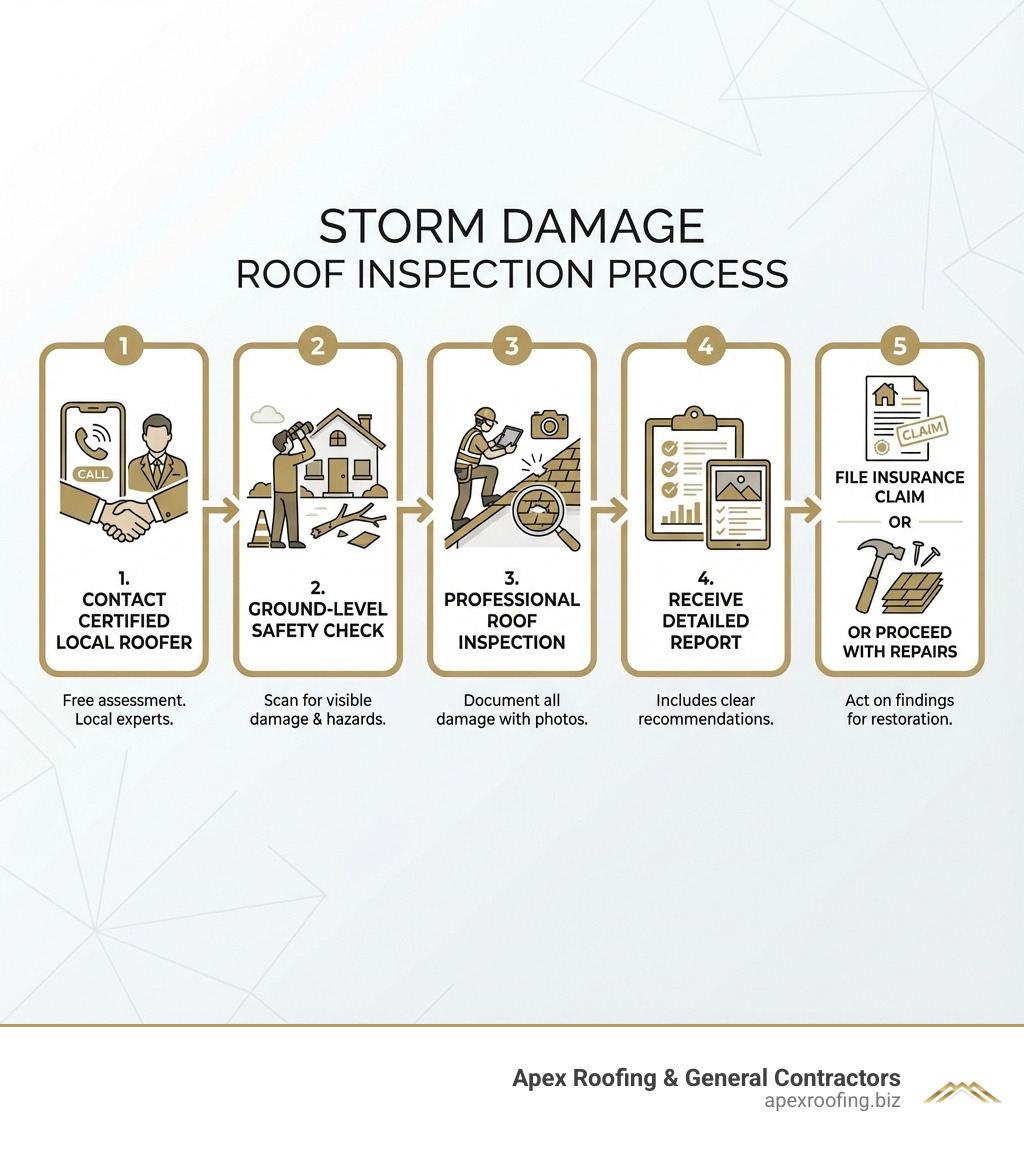
- Call a licensed local roofer first – Get a free, expert assessment before contacting insurance.
- Schedule within 24-48 hours – Document damage while storm evidence is fresh.
- Stay safe on the ground – Never climb on a wet or damaged roof yourself.
- Review the inspection report – Use photos and findings to file your insurance claim.
- Act fast – Most policies require claims within one year of damage.
As Carlos Yzaguirre, President of Apex Roofing & General Contractors, I’ve guided hundreds of San Antonio homeowners through the storm damage roof inspection process. Our team combines advanced roofing technology with straightforward communication to ensure you’re never left guessing about your roof’s condition.
Must-know storm damage roof inspection terms:
Your Post-Storm Safety Checklist: What to Do First
This initial assessment is about identifying immediate hazards and gathering information safely from the ground. Never climb on a potentially damaged roof; it could be wet, slippery, or structurally compromised. Your safety is the top priority. If you see downed power lines or suspect structural instability, call 911 immediately.

When assessing your roof after a storm, there are definite do’s and don’ts to keep in mind.
Do’s and Don’ts of Post-Storm Roof Assessment:
- DO prioritize safety. Wait until the storm has completely passed.
- DO a quick ground-level scan of your property for obvious signs of damage.
- DO use binoculars or a drone for a closer, safe look at your roof.
- DO check for downed power lines and stay far away.
- DO document everything you see with photos and videos from the ground.
- DO note the date, time, and details of the storm (hail size, wind speed) for insurance claims.
- DON’T ever climb onto a potentially damaged roof. It’s extremely dangerous.
- DON’T touch any exposed wires or damaged electrical systems.
- DON’T assume your roof is fine just because you don’t see damage from the ground.
- DON’T let anyone pressure you into signing contracts right after a storm.
What to Look For Inside Your Home
Interior signs are red flags that your roof’s defenses have been breached. Check these areas immediately after a storm and again a day or two later.
- Attic inspection: If safe, use a flashlight to check for moisture, wet or dark wood decking, active drips, or visible daylight through the roof boards.
- Ceiling water stains: Look for yellow, copper, or brown rings on ceilings, which are classic signs of a leak.
- Bubbling or peeling paint: Water can cause paint or wallpaper to bubble, crack, or peel on walls and ceilings.
- Damp spots around light fixtures: Water can travel along conduits. If you see dampness, turn off power to that area immediately to prevent fire hazards.
- Musty odors: A persistent musty smell in the attic or upper levels can indicate mold or mildew from hidden moisture, which can develop within 24-48 hours.
- Visible daylight through roof boards: Seeing light through the roof from your attic is a clear sign of a breach.
If you suspect any internal leaks, it’s critical to address them promptly. For more information on what to do, visit our guide on More info about what to do for a leaky roof.
What to Look For Outside Your Home (From the Ground)
Your yard and home’s exterior reveal the storm’s intensity and the likelihood of roof damage. These “collateral” damages are key indicators.
- Shingles in the yard: Finding shingles or shingle pieces on your property is an obvious sign of wind damage.
- Dented gutters and downspouts: Hail can cause dents on metal gutters and downspouts. Check for clogs from debris.
- Damaged siding or windows: Dents on siding or chipped window glazing indicate significant impact that likely affected your roof.
- Debris on the roof: Fallen branches or other debris could signal larger impacts that caused punctures or abrasions.
- Granules in downspout runoff: Check runoff for an excessive amount of asphalt granules, which look like sand. Their loss indicates shingle impact, often by hail.
- Damaged fences or patio covers: Dents or cracks on fences, patio covers, or your AC unit suggest the storm was severe enough to damage your roof.
Decoding the Damage: Signs of Wind, Hail, and Water
A professional inspector is trained to spot specific damage patterns that indicate how a storm has affected your roof. Different roofing materials show damage in unique ways, and understanding these signs helps you communicate with your roofer and insurance provider.
Signs of Hail Damage on Shingles
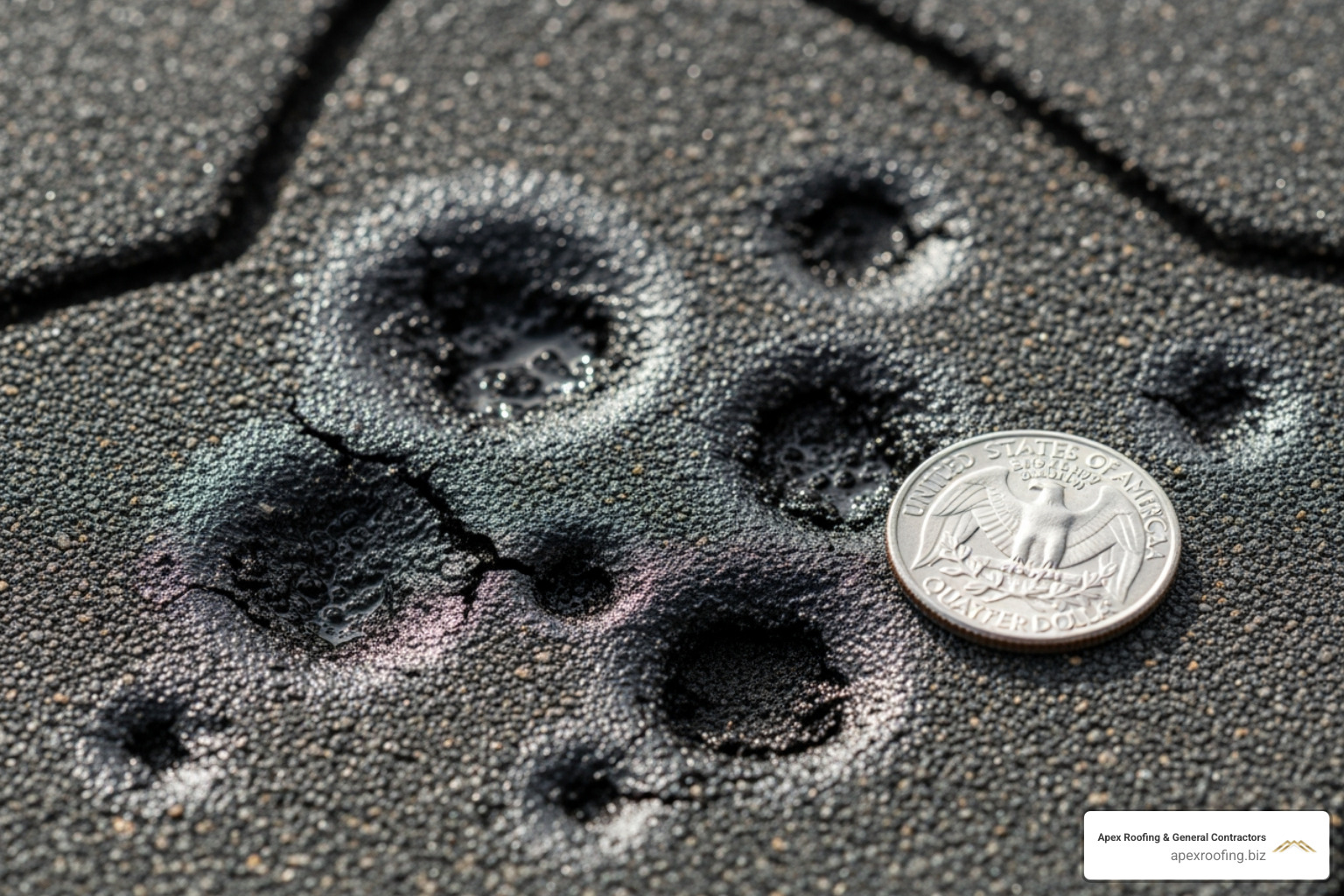
Hail damage often creates subtle “bruises” that weaken the shingle and lead to future failure. In San Antonio and Bexar County, we are particularly susceptible to hailstorms. Texas accounted for nearly a quarter of all U.S. properties affected by hailstorms in 2021, with an estimated 93,766 properties in Bexar County alone affected that year.
Here’s what a professional storm damage roof inspection for hail looks for:
- Random pattern of dents: Hail strikes are typically random, unlike manufacturing defects.
- “Bruised” or soft spots: Hail creates soft depressions, indicating the shingle’s matting is compromised.
- Loss of granules: Hail dislodges protective granules, exposing the asphalt layer (appearing as dark spots). This leads to granule buildup in gutters. For a visual guide, see our article on What hail damage looks like on a roof.
- Cracked shingles: Severe hail can crack the shingle’s fiberglass mat, sometimes in a starburst pattern.
- Dents on vents and flashing: Metal components like roof vents and flashing show hail dents more clearly.
- Wind speed impact: Hail damage is often worse during wind speeds over 30 mph. You can learn more about hail formation from the National Severe Storms Laboratory.
Signs of Wind Damage on Shingles
High winds don’t just blow shingles off; they can lift them, breaking the watertight seal and leaving them vulnerable to leaks. This is common in areas like Helotes and Alamo Heights. Gale-force winds (39-54 mph) or hurricane-force winds (74+ mph) can cause significant damage.
During a storm damage roof inspection, our team will look for:
- Missing shingles: The most obvious sign, leaving the underlayment exposed.
- Lifted or curled shingles: Wind breaks the shingle’s seal, causing them to lift and compromising their ability to shed water.
- Creased shingles: A crease indicates a shingle was lifted and bent back, causing structural fatigue.
- A distinct pattern of damage: Wind damage often follows a pattern, affecting one side of the roof or occurring along ridges and edges.
- Granule loss at the edges: Wind can cause granule loss along shingle edges due to friction from flapping.
If you’ve noticed missing or lifted shingles, address them quickly. Our guide on How to repair blown-off shingles offers more insights. For official wind classifications, refer to the National Hurricane Center.
How Different Roofing Materials Are Affected
The type of roofing material dictates how it will be impacted by a storm. From asphalt shingles in Shavano Park to metal roofs in Fair Oaks Ranch, each has unique vulnerabilities.
- Asphalt Shingles: Common in Bexar County, they are susceptible to granule loss, cracking, bruising (hail), and lifting/tearing (wind).
- Metal Roofs: Durable but can suffer from denting (hail), scratching, and loose panels from strong winds.
- Tile Roofs (Clay/Concrete): Prone to cracking, chipping, or dislodging from hail or high winds. Never walk on a tile roof yourself.
- Wood Shake/Shingle Roofs: Can split, crack, or rot, especially after being compromised by wind or hail.
Here’s a quick comparison of how common roofing materials fare against storm damage:
| Roofing Material | Common Storm Damage Signs | Susceptibility to Damage |
|---|---|---|
| Asphalt Shingles | Granule loss, cracks, bruising, lifted/missing shingles | Moderate to High |
| Metal Roofs | Dents, scratches, loose panels/fasteners, coating loss | Low to Moderate |
| Tile Roofs | Cracks, chips, dislodged tiles | Moderate |
| Wood Shake | Splitting, cracking, rotting, missing shakes | Moderate to High |
The Professional Storm Damage Roof Inspection Process
A qualified roofing contractor provides a comprehensive assessment that goes far beyond a simple visual check. This detailed inspection is crucial for a successful insurance claim, ensuring all damage is identified and documented.
What is Collateral Damage and Why is it Inspected?
“Collateral damage” refers to damage to other parts of your property that provides evidence of a severe storm. When we conduct a storm damage roof inspection, we inspect your entire property because damage to ground-level items helps prove a storm severe enough to damage your roof occurred. Insurance adjusters look for these secondary indicators as corroborating evidence.
Common collateral damage we look for includes:
- Dented mailboxes
- Damaged AC units (dented fins)
- Chipped window glazing or paint
- Damaged or dented fences
- Dented garage doors
- Torn window screens
Documenting these damages builds a strong case for your insurance claim, showing a pattern of storm activity.
How Roofing Contractors Document Storm Damage
Thorough documentation is non-negotiable for a successful insurance claim. Our professional inspectors use advanced methods to capture every detail:
- High-resolution photos: We take numerous clear photos of all damage, from wide-angle to close-ups.
- Videos of the inspection: Video provides a dynamic record illustrating the scope of the issues.
- Chalking hail hits: We circle individual hail strikes with chalk to make them clearly visible for the adjuster.
- Test squares (10’x10′ areas): We may mark out 10’x10′ “test squares” on different roof slopes to count hail hits, a standardized method to quantify damage.
- Written report: A detailed report accompanies all visual documentation, outlining the damage found and our professional assessment.
- Drone photography: For safety and thoroughness on steep or complex roofs, we use drones to capture high-resolution aerial images.
Why a Professional Storm Damage Roof Inspection is Crucial
A professional storm damage roof inspection by a licensed contractor is indispensable. It’s about understanding the subtle, hidden damage that can lead to long-term problems.
- Expertise and training: Our inspectors are trained to identify all types of storm damage, including nuanced signs an untrained eye would miss.
- Safety equipment: We use professional safety equipment to inspect your roof, eliminating risks to homeowners.
- Insurance claim assistance: We provide credible documentation for your claim and help you communicate with your insurance provider.
- Identifying hidden damage: We uncover subtle issues like hail “bruises” or lifted shingles that aren’t visible from the ground but can cause major problems.
- Unbiased assessment: Our free inspection provides an honest assessment. We only recommend filing a claim if we find legitimate, insurable damage, protecting your claims history.
For peace of mind, always trust Licensed Roof Inspectors who understand the weather patterns of San Antonio and surrounding Bexar County.
After the Inspection: Insurance Claims and Next Steps
Once your storm damage roof inspection is complete, you’ll have a clear path forward. The detailed report will be your guide for repairs or filing an insurance claim.
Roofer First or Insurance First?
Our advice is clear: always call a trusted local roofer for a free roof inspection before contacting your insurance company. This strategy benefits you:
- Avoid unnecessary claims: If there’s no insurable damage, you avoid filing a claim that could affect your premiums.
- Get an expert opinion: A roofer can accurately assess if damage meets your policy’s criteria, differentiating it from normal wear and tear.
- Contractor as advocate: If damage is found, your roofer acts as your advocate, providing documentation and meeting with the adjuster to ensure all damage is covered.
- Understanding your policy: Your roofer can help you understand your policy coverage and deductible.
- Time limits for filing: Most policies require claims within one year of the damage. A quick inspection ensures you don’t miss this window.
By calling a reputable San Antonio roofer like Apex Roofing first, you only file a claim when there is legitimate damage, protecting your claims history. You can find more information about finding local professionals at Roofers Near Me San Antonio.
Navigating the Roof Insurance Claim Process
If the inspection confirms significant damage, the next step is filing a claim. A good roofer will guide you through it.
- Filing the claim: Contact your insurance provider to initiate the claim. Provide the storm date and the detailed report from your roofer.
- Scheduling the adjuster meeting: Your insurer will send an adjuster. We highly recommend having your roofer present to ensure all damage is identified and properly evaluated.
- Reviewing the adjuster’s summary: Your roofer can help you review the adjuster’s summary and repair estimate to ensure it’s fair and comprehensive.
- Understanding ACV vs. RCV: Your policy may cover Actual Cash Value (ACV), the depreciated value, or Replacement Cost Value (RCV), the cost to replace with new materials. This difference is crucial.
- Supplementing the claim: If the adjuster’s estimate is insufficient, your roofer can submit a “supplement” with more documentation to ensure full coverage.
For a more in-depth understanding, refer to our comprehensive A guide to roof insurance claims.
What Storm Damage is Typically Covered?
Most homeowners insurance policies cover sudden and accidental damage from “perils” like wind and hail.
- Wind damage: Includes missing, lifted, or creased shingles and damage to flashing or vents.
- Hail damage: Covers granule loss, bruising, cracking, and dents to the roof and its components.
- Fallen trees/debris: Damage from trees or debris falling on your roof due to a storm is usually covered.
- Water damage from leaks: Interior water damage resulting directly from storm-related roof damage is typically covered.
Exclusions: Policies generally do not cover damage from neglect, wear and tear, or improper installation. If a storm exposes pre-existing issues on an old roof, coverage might be limited or denied. Your deductible will apply to any approved claim.
Frequently Asked Questions about Storm Damage Inspections
What are the consequences of neglecting a roof inspection after a storm?
Neglecting a storm damage roof inspection allows minor issues to become major, costly problems. Small leaks can lead to structural rot, mold growth, and damaged insulation, compromising your home’s integrity and air quality. If you delay, your insurance company may deny a future claim, attributing the damage to neglect instead of the original storm.
How can I prepare my roof to mitigate future storm damage?
Proactive maintenance is your best defense against storm damage. Key steps include:
- Regular maintenance: Perform biannual gutter cleaning and trim overhanging tree branches that could fall on your roof.
- Prompt repairs: Address any aging or damaged shingles promptly, as these are weak points where storm damage often begins.
- Upgrade to impact-resistant shingles: Consider Class 4 impact-resistant shingles for superior hail protection. They may also provide a discount on your homeowners insurance.
- Professional inspections: Schedule professional inspections biannually (spring and fall) and always after a significant weather event.
How much does a storm damage roof inspection cost?
Most reputable roofing contractors in the San Antonio area, including Apex Roofing & General Contractors, offer a comprehensive storm damage roof inspection for free. This allows us to provide an accurate assessment with no upfront cost. An inspection by an insurance adjuster as part of a claim is also covered by your policy. While specialized inspections (drone, infrared) can cost $200–$600, a standard visual inspection from a qualified roofer is typically complimentary.
Secure Your Home with a Trusted Partner
After a storm, uncertainty is the last thing you need. A professional storm damage roof inspection provides the clarity and documentation required to protect your home and steer the insurance process with confidence. By partnering with a certified, local expert, you ensure every detail is accounted for, from the initial assessment to the final repair. We are dedicated to serving our community in San Antonio, Helotes, Leon Valley, Alamo Heights, Fair Oaks Ranch, Shavano Park, Terrell Hills, and throughout Bexar County with transparent communication and reliable service.
If you suspect your roof has been damaged, don’t wait. For a free estimate, call the team at Apex Roofing & General Contractors today at (726) 727-7663 to schedule your free inspection.