Why Getting Competitive Roof Replacement Bids Can Save You Thousands
Getting competitive roof replacement bids is the single most effective step a homeowner can take before signing any roofing contract. When planning a major home improvement project, partnering with a trusted San Antonio roofing company ensures your investment is protected from day one. The difference between one quote and three quotes can be staggering — and the research backs this up.
Quick answer: How to get competitive roof replacement bids
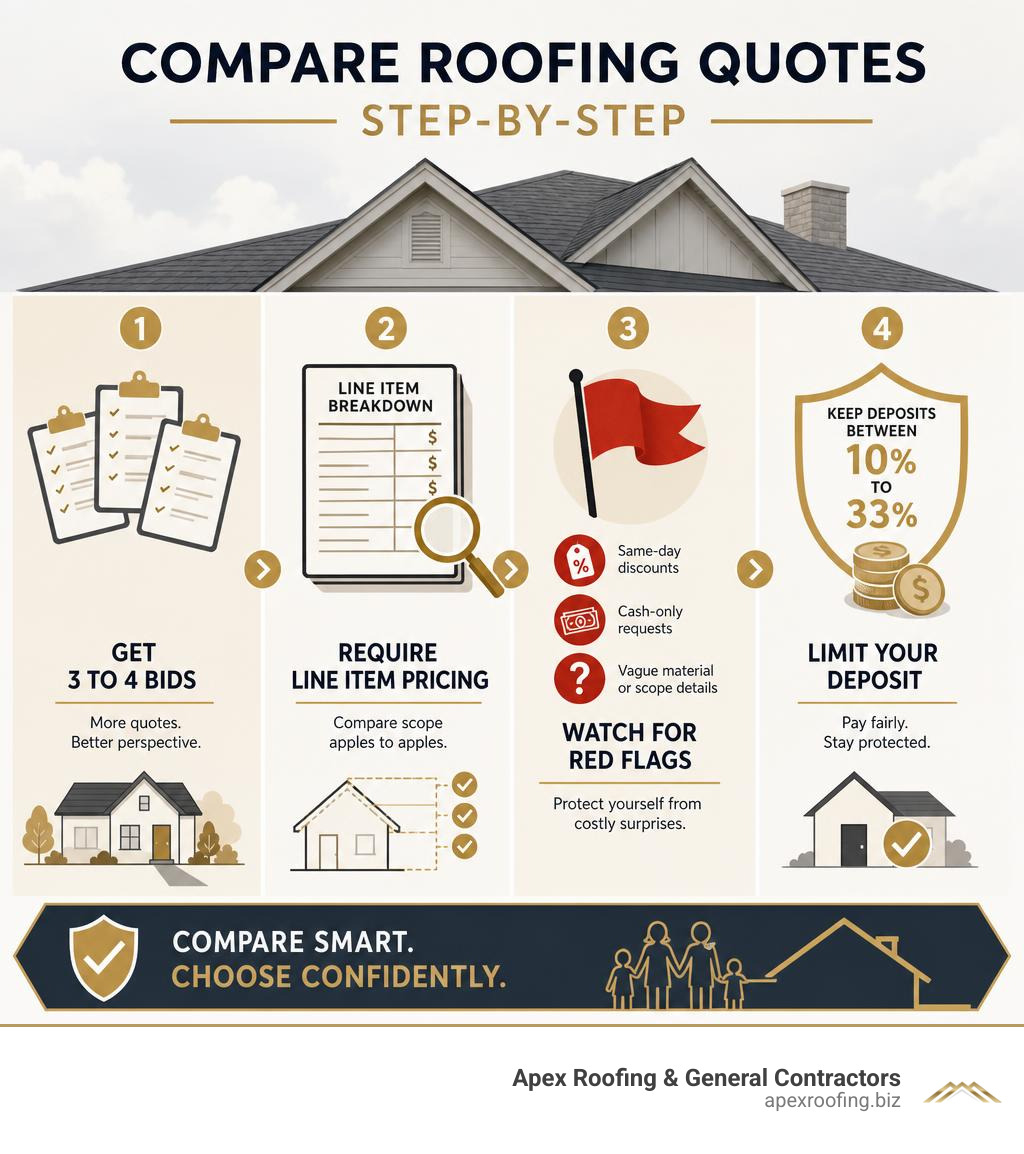
- Get 3 to 4 written quotes from licensed, insured local contractors
- Require line-item pricing — not lump sums — so you can compare scope directly
- Verify each contractor’s license, insurance, and manufacturer certifications
- Check for red flags like same-day discounts, cash-only requests, or vague material specs
- Use a shared scope baseline so every contractor prices the exact same project
- Limit your deposit to no more than 10% to 33% upfront
The stakes are real. San Antonio homeowners who skip comparing quotes overpay by an average of $2,000 to $5,000 on a typical roof replacement. In one documented case, a homeowner received a first quote of $30,000 for 25 squares of shingles — then found the same job quoted at $13,200 to $14,000 after getting two additional bids. That is a potential $16,000 mistake from skipping a single afternoon of phone calls.
On a standard residential re-roof, the typical variance between the lowest and highest legitimate bid runs from $4,000 to $12,000. That gap usually has nothing to do with dishonesty. It comes from contractors making different assumptions about scope — tear-off layers, underlayment type, decking repair, and material grade. Without a standardized comparison process, you are not comparing the same job.
This guide walks you through exactly how to fix that.
I’m Carlos Yzaguirre, President and Managing Partner of Apex Roofing & General Contractors in San Antonio. Since co-founding Apex in 2022, I’ve helped hundreds of Texas homeowners navigate competitive roof replacement bids — cutting through confusing quotes, mismatched scopes, and high-pressure sales tactics to find fair, quality-backed pricing. In the sections below, I’ll show you the exact framework we use to help clients compare bids with confidence.
Easy competitive roof replacement bids glossary:
Why You Need Multiple Competitive Roof Replacement Bids
To get the most accurate picture of the market, you must start by visiting a trusted local professional at Apex Roofing & General Contractors to establish a reliable baseline for your project. Relying on a single estimate often leads to extreme overpayment or, conversely, choosing an under-scoped bid that results in costly change orders down the road.

When you gather multiple bids, you force contractors to compete for your business, which naturally keeps pricing honest. However, bidding is a two-way street. Many successful roofing contractors aim for a 20 to 25 percent bid-hit-win ratio. This means they cannot afford to waste time on unserious inquiries, but they will put their best foot forward when they know they are in a fair, competitive environment.
By understanding the average roof replacement cost, you can easily spot which bids are priced fairly and which ones are wild outliers.
The Sweet Spot: Why Three to Four Quotes is Ideal
We recommend getting exactly three to four bids for your project. Getting fewer than three doesn’t give you enough data points to spot pricing anomalies, while getting more than five creates diminishing returns and leads to “analysis paralysis.”
With three or four quotes, clear patterns begin to emerge. You will quickly see the local market average for labor and materials in San Antonio. This range allows you to use a structured comparison tool to evaluate contractors side-by-side, balancing reputation, material quality, and price.
Understanding Price Variance in Competitive Roof Replacement Bids
The massive price variance in roofing bids is rarely due to simple price gouging. Instead, it stems from different bidding methodologies and scope assumptions. On a standard 2,500-square-foot home, one estimator might calculate the roof area using a basic ground measurement, while another uses high-precision satellite data.
Additionally, some contractors bid assuming they will reuse your existing flashing and drip edge to keep costs low, while others include entirely new system components to ensure a valid manufacturer warranty. If one contractor quotes $13,200 and another quotes $21,000 for the same home, look closely at the specifications — you will almost always find that the higher bid includes comprehensive system upgrades, while the lower bid is stripped to the bare minimum.
Key Line Items Every Legitimate Roofing Estimate Must Include
A legitimate roofing bid should never be a single-page document with a lump-sum price at the bottom. If you want to avoid hidden fees and ensure you are comparing apples to apples, require every contractor to provide a detailed, itemized estimate.
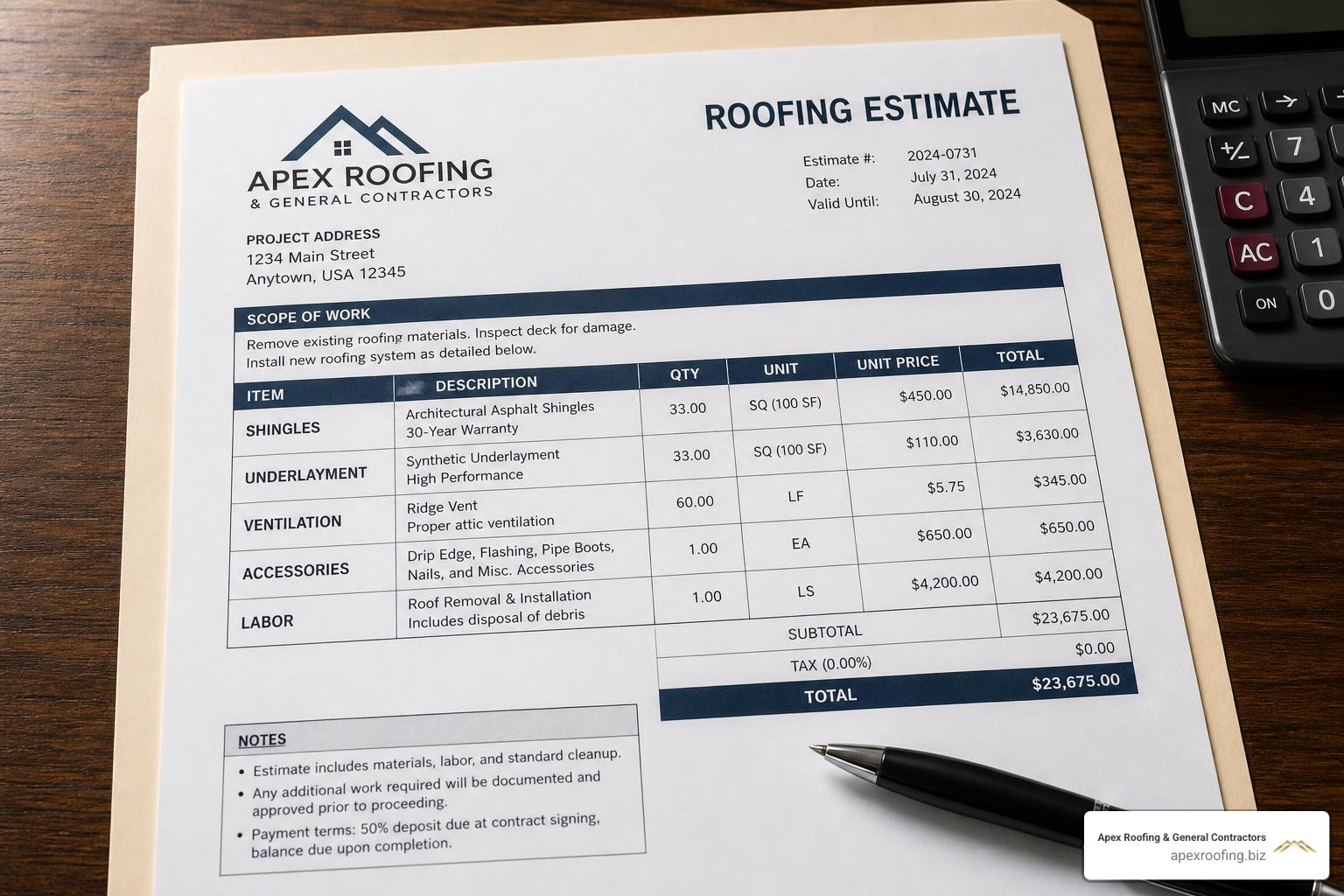
You can check your estimates against our new roof cost calculator to verify if the line-item rates align with current May 2026 market standards in South Texas.
Materials, Underlayment, and Ventilation Specifications
Every bid must explicitly state the brand, manufacturer, and line of shingles being proposed. Do not accept generic terms like “30-year architectural shingles.” Demand specifics, such as “Owens Corning Duration” or “GAF Timberline HDZ.”
Your bid must also detail the accessory materials. Ensure the estimate specifies:
- Underlayment: Synthetic underlayment is the modern standard; avoid contractors still using cheap 15-lb felt paper.
- Ice and Water Shield: Essential for valleys, penetrations, and low-slope transitions.
- Drip Edge: Must be specified by linear footage and metal gauge.
- Ventilation: The quote must outline whether they are installing ridge vents, box vents, or solar-powered attic fans to prevent heat buildup.
Understanding these details is critical, especially when determining when does your roof need replacement versus a simple repair.
Tear-Off Scope, Decking Repair, and Disposal Fees
One of the largest hidden variables in a roofing contract is how the contractor handles the tear-off and the wood deck underneath. Your bid must state that the project includes a complete tear-off of all existing layers down to the bare wood deck.
Furthermore, look for a specified “decking repair allowance.” A professional bid will state a flat rate per sheet of plywood or oriented strand board (OSB) if rotten wood is discovered. If this rate is not written down upfront, a contractor can charge inflated fees once your roof is torn open and you have no choice but to pay. Finally, ensure that permit fees, dump fees, and daily property cleanup are explicitly included in the total cost.
How to Normalize and Compare Roofing Quotes
To make an informed decision, you must “normalize” your bids. Normalization is the process of adjusting quotes so you can compare them on an equal basis. If Contractor A quotes $10,000 for standard 3-tab shingles and Contractor B quotes $12,500 for Class 4 impact-resistant architectural shingles, Contractor B may actually represent the better long-term value.
| Comparison Variable | Standard/Low-End Bid | Premium/High-Value Bid |
|---|---|---|
| Shingle Tier | 3-Tab Asphalt (Basic) | Architectural / Impact-Resistant (Class 4) |
| Underlayment | 15-lb Asphalt Felt | High-Performance Synthetic |
| Ice & Water Shield | None or Minimal | Valleys, Chimneys, and Eaves |
| Drip Edge | Reused Existing | New Aluminum (Pre-painted) |
| Decking Allowance | Not Mentioned (Charged Later) | 2 Sheets Included; Fixed Rate/Sheet |
| Workmanship Warranty | 1 to 2 Years | 10 Years to Lifetime |
If you struggle to normalize these components, you might find that your three roofing bids are useless without a systematic way to align their scopes.
Establishing an Independent Scope Baseline
The most effective way to eliminate bid variance is to establish an independent scope baseline before you invite contractors to your home. You can do this by hiring an independent inspector or using a highly rated local contractor to write a detailed “Scope of Work” document.
This document should list the exact square footage of your roof, the pitch, the linear footage of valleys and eaves, and the required building code upgrades. When you contact other roofing companies, hand them this baseline document and say, “Please quote exactly this scope.” This forces them to compete purely on labor efficiency, overhead, and material purchasing power rather than guessing at the dimensions.
Evaluating Warranties and Payment Terms
Do not confuse a manufacturer’s material warranty with a contractor’s workmanship warranty.
- Manufacturer Warranty: Covers defects in the shingles themselves (typically 25 to 50 years).
- Workmanship Warranty: Covers installation errors (typically 2 to 10 years, though premium contractors offer lifetime guarantees).
Your bids must clarify who handles warranty claims and whether the coverage is transferable if you sell your home.
Additionally, evaluate the payment terms. A reputable roofing contractor should never demand a large deposit upfront. In Texas, a standard deposit ranges from 10% to 33% of the total contract value. Never pay more than 33% before materials are delivered to your driveway, and never make the final payment until the job is completed, inspected, and you have received a signed lien waiver.
Red Flags and Scams to Avoid in Roofing Quotes
The roofing industry is unfortunately known for high-pressure sales tactics and outright scams, particularly after major hailstorms in the San Antonio area.
Familiarizing yourself with our new roof cost San Antonio guide will help you benchmark local pricing and protect yourself from predatory estimators.
Under-Scoping and Hidden Fees
The most common predatory tactic is “under-scoping.” A dishonest contractor will deliberately write a low-ball bid to win the contract, omitting essential items like flashing replacement, ventilation upgrades, or rotten decking.
Once your old roof is torn off and your home is exposed to the elements, they will issue high-priced “change orders” for these “unexpected” issues. If a bid is 20% to 25% lower than all other quotes, it is almost certainly under-scoped. Always ask: “Is this price guaranteed, or are there scenarios where the price will increase?”
Storm Chasers and Licensing Scams
After a severe South Texas storm, out-of-state “storm chasers” flood the San Antonio area. They often knock on doors offering to “waive your insurance deductible” or provide a “free roof” if you sign a contract immediately.
Be warned: In Texas, it is a class A misdemeanor for a contractor to pay, waive, or absorb an insurance deductible. Additionally, Texas does not have a statewide licensing requirement for roofing contractors. This makes it incredibly easy for unlicensed, unbonded, and uninsured out-of-state companies to perform substandard work and disappear before the next rainstorm. Always choose local roofers in San Antonio with a physical office in the area or nearby communities like Helotes or Alamo Heights.
How to Verify Contractor Credentials and Normalize Bids
Before awarding a contract, you must thoroughly vet your top choices. A 2023 report by the National Association of Realtors (NAR) found that homeowners who thoroughly vet their roofing contractors see a significantly higher return on investment and experience far fewer post-installation issues.
If you want to see what a fully certified, locally compliant bid looks like, check out our guide to roof replacement in San Antonio.
Checking Licensing, Insurance, and Local References
Because Texas lacks a state-level roofing license, you must verify professional credentials through other channels. Ask if the contractor is a member of the Roofing Contractors Association of Texas (RCAT), which maintains strict voluntary licensing standards.
More importantly, demand to see their Certificate of Insurance (COI) showing active General Liability and Workers’ Compensation coverage. Do not just accept a paper copy; call the insurance agency listed on the certificate to verify that the policy is active. If an uninsured worker is injured on your property, you could be held legally liable for their medical expenses. Finally, ask for three local references for jobs completed within the last six months and call them to ask about their cleanup and communication experience.
The Value of Manufacturer Certifications in Competitive Roof Replacement Bids
The easiest way to identify a top-tier roofing contractor is by checking their manufacturer certifications. Major manufacturers only certify a small percentage of contractors who meet rigorous standards for financial stability, ongoing training, and installation excellence.
Look for designations such as Owens Corning Platinum Preferred or Malarkey Emerald Pro. These certifications allow the contractor to offer extended, non-prorated manufacturer warranties that cover both materials and labor for up to 50 years. If a contractor holds these credentials, it is a strong indicator of long-term reliability and exceptional craftsmanship.
Frequently Asked Questions about Roofing Bids
How many roofing quotes should I get?
You should get three to four written quotes from local, established roofing companies. Getting fewer than three doesn’t provide enough data to identify pricing outliers, while getting more than four or five can make the comparison process overwhelming without adding significant value.
What is a reasonable deposit for a roof replacement?
A reasonable deposit is 10% to 33% of the total project cost. You should never pay more than one-third of the contract value upfront. Many highly reputable contractors require zero deposit at signing, only requesting payment once materials are delivered to your property or after the project is fully completed.
Why are my roofing bids so different in price?
Roofing bids vary widely because of differences in scope assumptions, material quality, and overhead. One contractor may include a complete system replacement with high-performance synthetic underlayment and new flashing, while another may plan to reuse old materials and install basic shingles. Always check the itemized line items to ensure you are comparing identical projects.
Conclusion
Securing competitive roof replacement bids is not just about finding the lowest price — it is about ensuring your home is protected by a high-quality, code-compliant roofing system installed by a verified professional. By establishing a clear scope baseline, normalizing material specifications, and thoroughly vetting contractor credentials, you protect yourself from predatory pricing and substandard workmanship.
When you are ready to partner with a certified, reliable local specialist who prioritizes transparent communication and strict building code compliance, contact Apex Roofing & General Contractors today. We offer free estimates to help you make the best decision for your home. Call us at (726) 727-7663 to schedule your free inspection, or schedule your residential roof replacement today.