Why Understanding Local Storm Damage Reports Matters for Texas Homeowners
Local storm damage affects thousands of Texas homeowners annually, causing billions of dollars in property repairs. After a severe storm, knowing where to find official damage reports—and how to read them—can mean the difference between a quick insurance claim and months of frustration. For homeowners in areas like San Antonio needing certified, reliable service, understanding this data is the first step toward recovery.
Here’s what you need to know about accessing local storm damage information:
- Official reports come from the National Weather Service (NWS) and Storm Prediction Center (SPC).
- Key data includes wind speeds, hail sizes, tornado paths, and exact times/locations of damage.
- Reports are available within hours (preliminary) or 90-120 days (finalized) after an event.
- Local NWS offices provide the most accurate data for your specific area.
- Storm damage reports help you document claims and justify repairs to insurance companies.
When you can’t tell if a storm damaged your roof, official reports provide the proof you need. They document wind speeds, hail sizes, and the exact time severe weather hit your property—all critical information for storm damage repair claims. However, most homeowners don’t know where to find these reports or how to interpret the technical language. A report might say “quarter-sized hail” or “EF0 tornado,” but what does that mean for your roof?
I’m Carlos Yzaguirre, President of Apex Roofing & General Contractors. Since 2022, my team has helped hundreds of San Antonio homeowners steer local storm damage claims. We use these official reports to verify damage and ensure homeowners get the coverage they deserve.
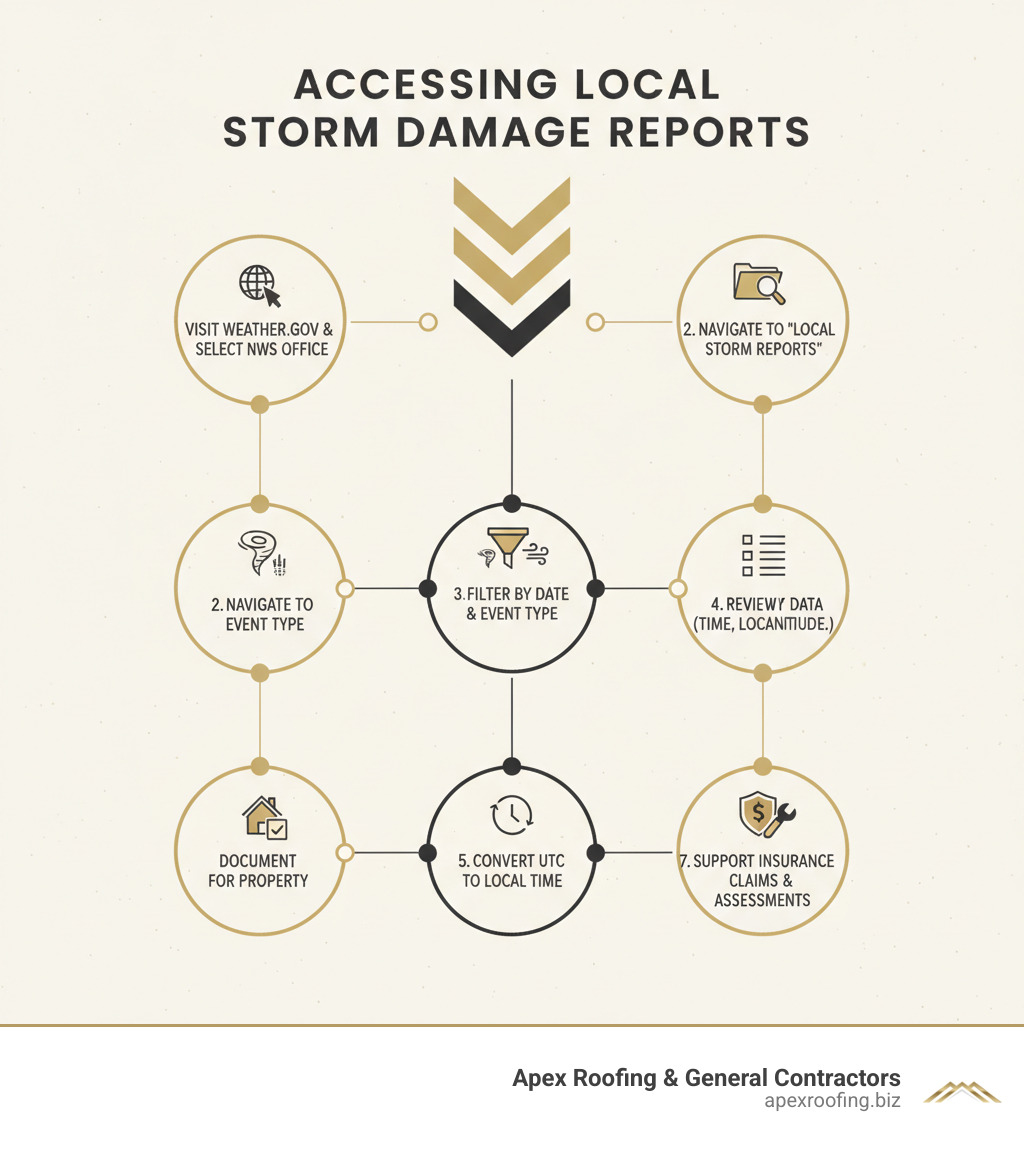
Where to Find Official Storm Damage Reports
To build a solid case for your insurance claim, you need official documentation of local storm damage. The gold standard for these reports comes from government agencies like the National Weather Service (NWS) and the Storm Prediction Center (SPC).
These agencies operate local forecast offices that collect real-time data on every significant weather event. For historical data, the most comprehensive resource is the official Storm Events Database, which contains weather records dating back to 1950. This data is highly reliable because it is compiled from multiple verified sources, including damage surveys, emergency managers, law enforcement, and trained SKYWARN spotters.
How to Find Your Report
Navigating government weather websites is straightforward once you know the steps:
- Start at weather.gov: Enter your city or zip code to go to your local NWS office page.
- Find Local Reports: Look for a section labeled “Local Storm Reports” or “Past Weather.”
- Select a Date: View reports for recent events or use the NCDC Storm Events Database for older storms.
- Filter by Event Type: Narrow your search to specific events like Tornado, Hail, or Wind. Each report will include the time, location, event type, and a factual description of what occurred.
Official vs. Unofficial Sources
While social media provides immediate eyewitness accounts, insurance claims require official, verified data. NWS reports undergo rigorous validation by trained meteorologists. Preliminary reports are available quickly, but the final, official records appear in the NCDC Storm Data publication 90 to 120 days after an event. This verification process makes them the most credible documentation for your insurance company. When you need authoritative data for a claim or to hire a roofing contractor, always go directly to the NWS or NCDC.
How to Read and Understand a Storm Report
Once you find a storm report, you need to interpret its technical terms to understand what happened to your property. These reports contain vital clues for your recovery.

A Local Storm Report (LSR) follows a standard format. Here are the key elements:
- Event Type: This identifies the weather phenomenon, such as a Tornado (rotating column of air), Hail (ice pellets), or straight-line Wind.
- Magnitude Scales: This measures the storm’s intensity. For tornadoes, the EF Scale (EF0 to EF5) is used; even an EF0 (65-85 mph winds) can tear off shingles. For hail, size is reported in inches or by comparison (e.g., “quarter-sized”), which is critical for determining potential roof damage. Wind speed is reported in miles per hour (mph), with speeds over 50 mph posing a significant threat.
- Location Data: The report pinpoints the event using latitude/longitude coordinates and the nearest town or county. This is crucial because storm effects can vary over short distances.
- Time Stamps: Reports use UTC time, which requires conversion to your local time. Reports are often marked preliminary, meaning they are based on initial observations and may be updated.
For a visual analysis, you can use an interactive Local Storm Report App to see reports overlaid on radar data. Understanding the report is the first step before you can determine what hail damage looks like on a roof.
Decoding Common Abbreviations and Codes
Storm reports use abbreviations for efficiency. Here are some common ones:
- LSR: Local Storm Report
- TSTM: Thunderstorm (e.g., TSTM WND for thunderstorm wind)
- TOR: Tornado touchdown
- EF-Scale: Improved Fujita Scale for tornado intensity
- HAIL 1.00 IN: One-inch diameter hail
- WND: Damaging straight-line winds
- UTC: Coordinated Universal Time
- LAT/LON: Latitude/Longitude coordinates
- SVR: Severe (indicates hail ≥1 inch or winds ≥58 mph)
Converting UTC to Your Local Time
All meteorological reports use UTC (Coordinated Universal Time) to maintain a global standard. You must convert this to your local time to accurately match the report to the damage on your property.
For Texas, which is in the Central Time Zone:
- Central Standard Time (CST): Subtract 6 hours from UTC.
- Central Daylight Time (CDT): Subtract 5 hours from UTC (observed from March to November).
For example, a report of hail at “2200 UTC” in July (CDT) would be 5:00 PM local time (22:00 – 5:00). Accurate time conversion is essential for validating your insurance claim.
Common Types of Damage Found in Local Storm Damage Reports
Official reports document specific types of local storm damage, helping you know what to look for on your property. Understanding these categories is key to a thorough inspection and insurance claim.
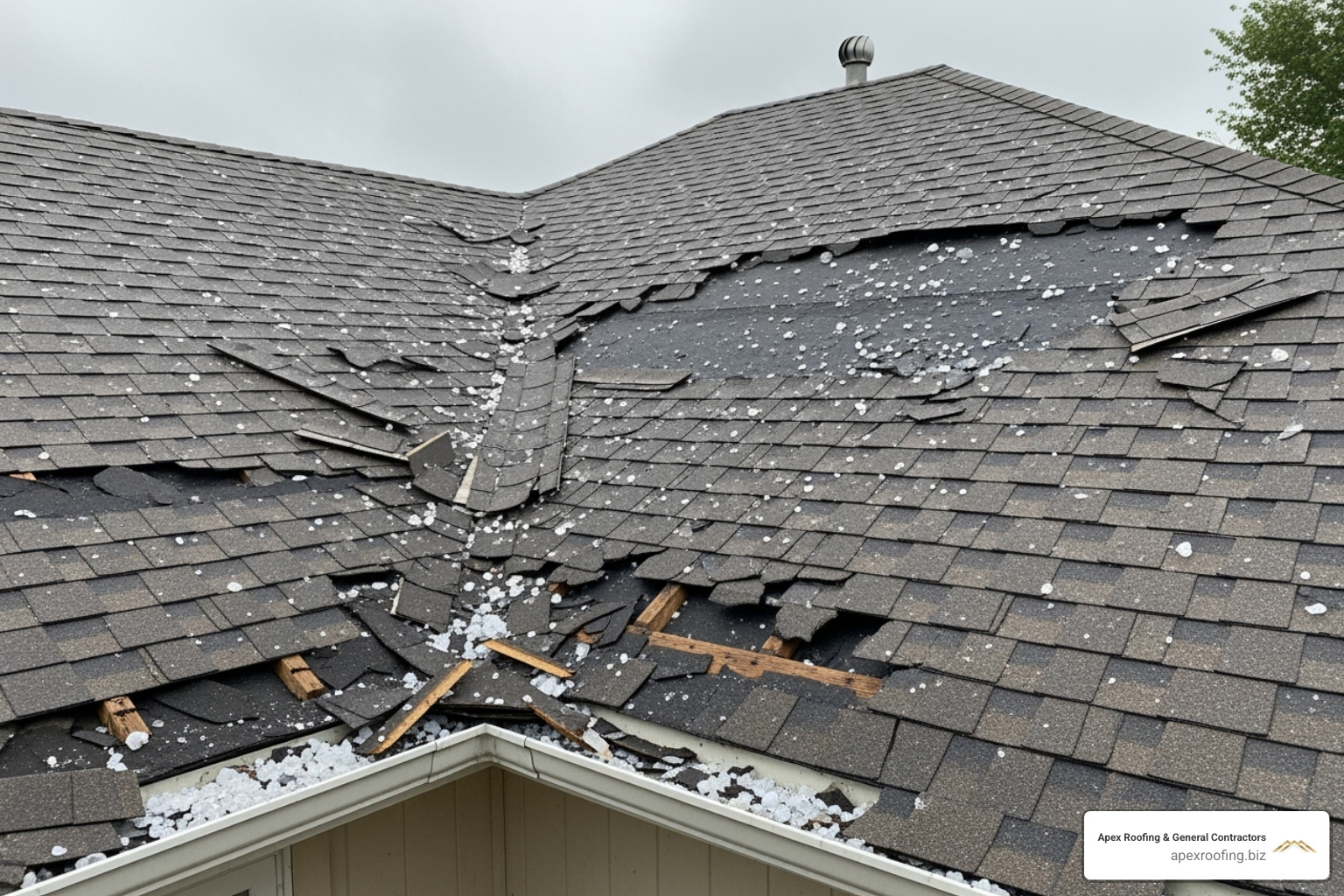
Storm reports focus on these primary damage categories:
- Wind Damage: High winds can tear off shingles, damage siding, and collapse weaker structures. Gusts over 50 mph pose a serious risk to roofing systems.
- Hail Damage: Hailstones can dent, crack, or puncture roofing, siding, and windows. The cumulative effect of many small impacts can drastically shorten a roof’s lifespan.
- Water Damage: Heavy rainfall can lead to leaks through damaged roofs and windows, causing mold and structural weakening over time.
- Debris Impact: Wind-borne objects like branches or patio furniture can puncture roofs and break windows.
- Fallen Trees: A clear sign of a powerful storm, fallen trees can cause catastrophic structural damage to homes and vehicles.
- Power Outages: Widespread outages indicate that the storm was severe enough to damage infrastructure, signaling the need for a property inspection.
Identifying Wind and Debris Damage in Your Area
When reviewing reports for wind events, look for these key indicators:
- Downed Trees and Branches: Widespread tree damage confirms that your property experienced significant wind forces.
- Power Line Damage: Reports of downed power lines are a reliable sign of severe winds.
- Structural Damage: Look for mentions of damaged fences, awnings, or roof sections.
- Reported Wind Speed: NWS reports provide actual wind gust speeds. For roofing, winds of 50-60 mph can begin lifting shingles, while speeds over 100 mph can cause total system failure.
Seeing these indicators in reports for your location means your property likely sustained impacts that require professional inspection.
Assessing Hail Impact from a local storm damage report
Hail damage is often subtle but can severely compromise your roof. Storm reports provide two crucial details for assessing the risk: hail size and location.
Reports describe hail size in inches or by comparing it to common objects: quarter-sized (1.00″), golf ball-sized (1.75″), or baseball-sized (2.75″). Even quarter-sized hail can cause significant granule loss and bruising on asphalt shingles, which may not be visible from the ground but leads to future leaks. Larger hail can puncture roofing materials, crack siding, and shatter windows.
Understanding these reports helps you know what hail size causes roof damage. An official report of significant hail in your area is the first clue that you need a professional inspection to assess the full extent of the damage for your storm damage repair claim.
What to Do After Confirming Storm Damage
Confirming your home has suffered local storm damage can be overwhelming. Taking these immediate, methodical steps can turn a crisis into a manageable process.
- Prioritize Safety: Before inspecting anything, check for hazards. Stay far away from downed power lines and call the utility company. If you suspect structural damage (e.g., sagging ceilings) or smell gas, evacuate immediately and contact emergency services.
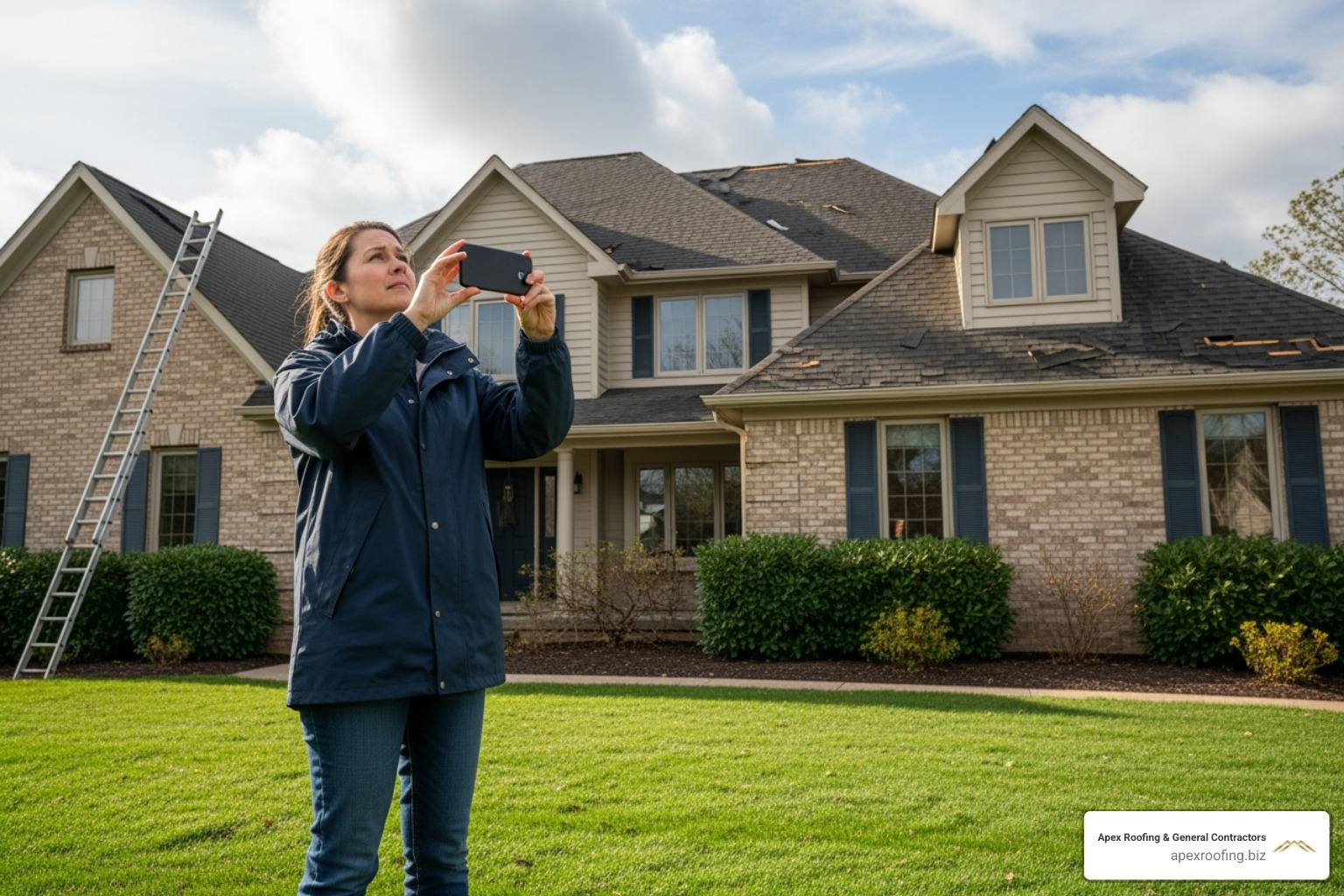
- Document Everything: Use your smartphone to take extensive photos and videos of all damage. Capture wide shots for context and close-ups of specific issues like lifted shingles, dented gutters, or cracked siding. This documentation is the foundation of your insurance claim.
- Prevent Further Damage: If your roof has holes or missing shingles, cover the area with a tarp to prevent water from entering. Most insurance policies require you to take reasonable steps to mitigate further damage. Only attempt this if you can do so safely; otherwise, call a professional.
- Contact Your Insurance Agent: File your claim as soon as possible. Have your photos and any official storm reports ready. Your agent will guide you through the claims process.
The Importance of a Professional Inspection for local storm damage
While your photos are a good start, a professional inspection is essential to identify the full scope of damage. Many issues, like hail bruising on shingles or wind-lifted seals, are invisible from the ground and can lead to leaks months later.
A certified inspector will:
- Identify Hidden Damage: They are trained to spot subtle signs of damage that can compromise your roof over time.
- Assess Structural Integrity: A professional checks the underlying roof decking and structure for water intrusion or stress that could lead to serious problems.
- Provide a Detailed Report: A contractor’s report provides the technical documentation and evidence that insurance adjusters require, making it much harder to dispute your claim.
A professional inspection provides peace of mind that all damage has been found. For a complete overview, see this guide to professional roof inspections.
When to Call for Emergency Repairs
Some situations require immediate action to prevent catastrophic loss. Call for emergency service if you experience any of the following:
- Active Leaks: Water pouring into your home can quickly cause widespread damage to the interior, insulation, and electrical systems.
- Major Structural Compromise: A sagging roofline, a large hole, or a section of missing roof indicates a severe structural failure that could lead to collapse.
- Immediate Safety Hazards: A large tree branch on your roof or exposed electrical wiring poses a direct threat to your family’s safety.
- Exposed Roof Decking: When shingles and underlayment are torn away, the exposed wood decking can absorb water and rot quickly, compromising the entire roof structure.
In these scenarios, an emergency crew will secure your property with tarps or other materials to prevent further damage while you arrange for permanent repairs. If you need emergency roofing services, do not wait.
Frequently Asked Questions about Storm Damage
Dealing with local storm damage brings up many questions. Here are concise answers to the most common inquiries we receive.
How soon after a storm are reports available?
Preliminary reports from the Storm Prediction Center are often available within hours. These are useful for immediate assessment. However, official, finalized reports from the NCDC Storm Data publication, which are best for insurance claims, may take 90 to 120 days to be released after thorough verification.
What is the difference between a storm ‘watch’ and a ‘warning’?
A watch means conditions are favorable for severe weather to develop. It is a signal to stay informed and be prepared. A warning means severe weather is imminent or already occurring. This is a signal to take immediate action and seek shelter.
Can I submit my own storm damage report?
Yes, the National Weather Service encourages citizen reports through its SKYWARN program or local office websites. Your eyewitness account of hail size, wind damage, or flooding provides valuable ground-truth information that helps meteorologists verify storm impacts and improve future forecasts.
Conclusion: From Information to Action
Understanding how to find and interpret local storm damage reports empowers you to take swift, effective action. These official records provide the proof you need for insurance claims and help you understand the necessity of professional repairs. Once you have the data, the next step is to partner with a trusted expert. For homeowners in the San Antonio area, Apex Roofing & General Contractors offers certified, reliable service to restore your home and peace of mind. If you’ve confirmed storm damage, don’t wait for the problem to worsen. Call us at (726) 727-7663 for a free inspection and estimate.