When Storm Damage Hits, Roof Claim Assistance Can Make or Break Your Settlement
Roof claim assistance is professional support — typically from an experienced roofing contractor — that helps homeowners document damage, navigate insurer requirements, and maximize their insurance payout after a storm. If you need a quick answer on how to get started, here’s what matters most:
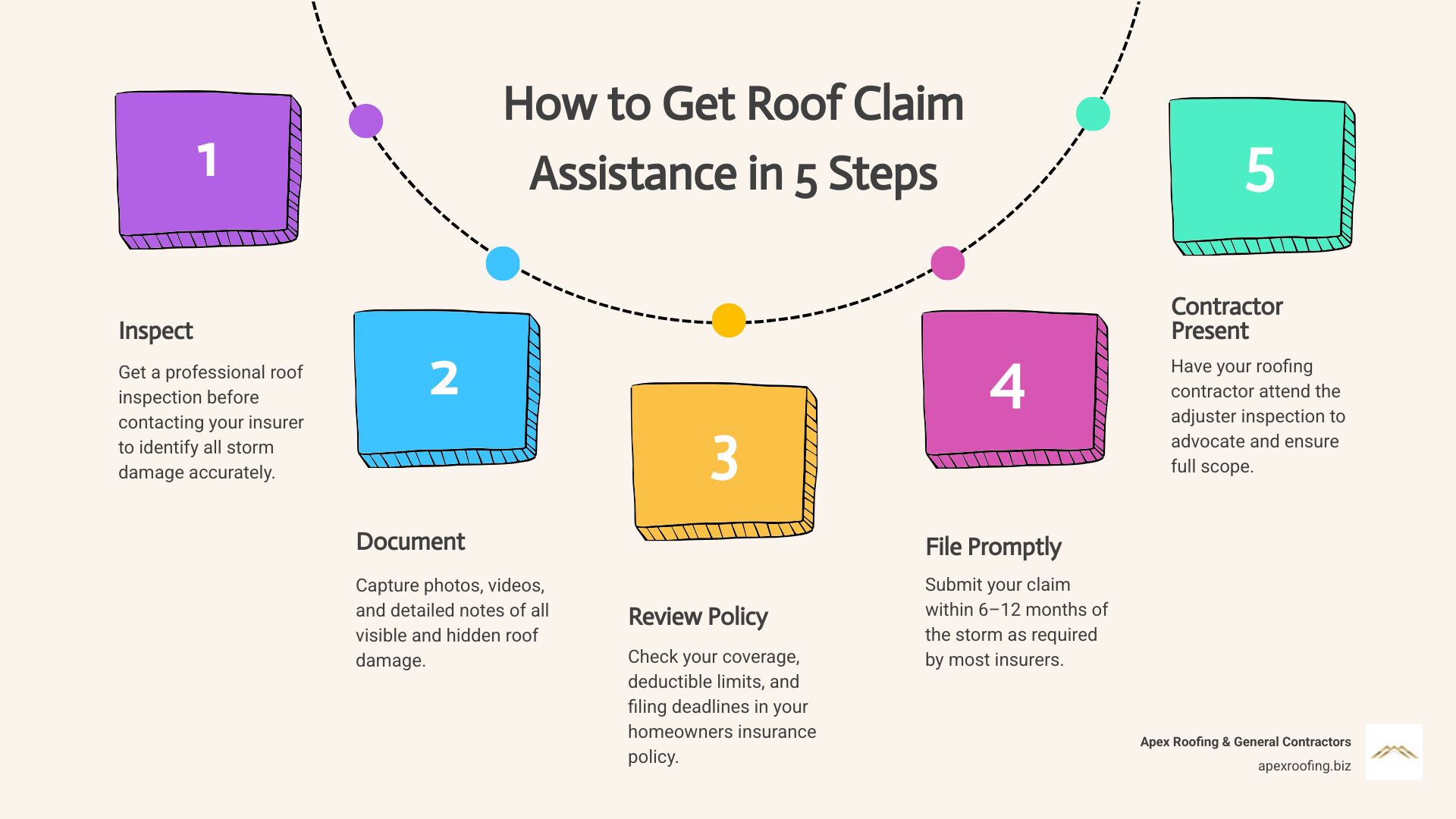
How to get roof claim assistance in 5 steps:
- Get a professional roof inspection before contacting your insurer
- Document all damage with photos, videos, and written notes
- Review your policy to understand your coverage, deductible, and filing deadlines
- File your claim promptly — most insurers require claims within 6–12 months of the event
- Have your contractor present during the adjuster’s inspection to advocate for you
Storms in Texas can be brutal. One day your roof looks fine, and the next you’re spotting water stains on the ceiling, missing shingles in the yard, or dents along your gutters. The damage isn’t always obvious — and that’s exactly where most homeowners run into trouble.
Residential roof insurance claims in the U.S. reached $31 billion in 2024, up nearly 30% since 2022, driven largely by wind and hail. Yet approximately 37% of property insurance claims are denied — often due to poor documentation, late filing, or misunderstood policy terms. Even more striking: nearly 65% of homeowners delay filing out of fear their claim won’t be approved.
That delay can cost you. Working with San Antonio roofing experts early — before you call your insurer — is one of the most effective ways to avoid common filing mistakes and protect your settlement.
This guide walks you through everything: what’s covered, how to file, how to handle denials, and what to expect at every stage of the process.
I’m Carlos Yzaguirre, President and Managing Partner of Apex Roofing & General Contractors, and I’ve guided hundreds of San Antonio homeowners through the roof claim assistance process since co-founding Apex in 2022. In the sections ahead, I’ll share exactly what works — and what to avoid — so you can move through your claim with confidence.
Roof claim assistance terms simplified:
What Damages Qualify for a Roof Insurance Claim?
Understanding what qualifies as a “covered peril” is the foundation of any successful claim. In insurance, a peril is a specific risk or cause of loss. Most standard homeowners insurance policies in San Antonio are “open peril” policies for the dwelling, meaning they cover everything unless it is specifically excluded.
Common Covered Damages
- Hail Impact: Hail is directional and its impact depends on the roof’s slope. It often causes “bruising” on composition shingles (granule loss) or splitting and gouging on wood shingles.
- Wind Damage: High winds can rip shingles entirely off the roof or lift them just enough to break the sealant bond, creating “creased” shingles that are no longer watertight.
- Falling Tree Limbs: Sudden impacts from debris during a storm are almost always covered.
- Lightning Strikes and Fire: These are classic examples of sudden, accidental damage.
- Rain Damage from Openings: If wind or hail creates a hole in your roof, the resulting water damage to your interior is typically covered.
According to the Verisk 2024 roof claims report, the surge in claims to $31 billion was largely fueled by these non-catastrophic wind and hail events. This highlights that you don’t need a hurricane to justify a claim; a standard Texas thunderstorm can do enough damage to warrant a full replacement.
What is Usually NOT Covered?
Insurance is designed to protect you from “sudden and accidental” events, not the inevitable passage of time. You can learn more about these distinctions in our guide on Does Homeowners Insurance Cover a New Roof?.
Common exclusions include:
- Wear and Tear: If your shingles are simply reaching the end of their 20-year lifespan, insurance won’t pay for a refresh.
- Poor Maintenance: Clogged gutters that cause wood rot or ignored minor leaks that turn into major mold issues are often denied.
- Manufacturer Defects: If the shingles themselves were faulty from the factory, that is a warranty issue, not an insurance one.
- Pre-existing Damage: Damage that occurred before your policy started or from a storm years ago that you failed to report.
The Step-by-Step Process for Professional Roof Claim Assistance
Filing a claim can feel like a full-time job. To ensure you don’t miss a beat, follow this professional workflow we use at Apex Roofing.

1. Professional Roof Inspection
Before you pick up the phone to call your agent, call a trusted local roofer. Why? Because once you file a claim, it goes on your record regardless of whether you get paid. A free storm damage roof inspection allows us to determine if there is actually enough damage to exceed your deductible.
2. Evidence Gathering
We don’t just look at the roof; we document it. This includes high-resolution photos of bruised shingles, dented soft metals (like vents and gutters), and any interior water spots. We also pull local weather data to correlate the damage with a specific storm date.
3. Filing the Claim
Once the damage is confirmed, you’ll contact your insurance company’s claims department. Provide them with the “Date of Loss” and a brief description of the event (e.g., “Hail storm on April 12th”). You’ll receive a claim number—keep this handy!
4. The Adjuster Meeting
The insurance company will send an adjuster to verify the damage. This is the most critical stage of roof claim assistance. We make sure to be on-site during this meeting to walk the roof with the adjuster, pointing out the specific damage we found during our initial storm damage roof inspection guide walkthrough.
5. Claim Approval and Supplementing
If the adjuster agrees, you’ll receive a “Scope of Loss” document and an initial check. Sometimes, adjusters miss things—like local building codes that require a full deck replacement. We handle the “supplementing” process, sending additional evidence to the insurer to ensure the full cost of the repair is covered.
Why You Need Expert Roof Claim Assistance Before Filing
An insurance adjuster works for the insurance company. While many are fair, their goal is to minimize the company’s loss. A roofing contractor works for you. We provide an unbiased evaluation.
Furthermore, we know what hail size causes roof damage. While a homeowner might see a “clean” roof from the ground, we can identify the microscopic fractures in the asphalt matting that lead to leaks six months down the road.
How a Contractor Supports the Adjuster Inspection
Adjusters often have 5-6 inspections a day during peak storm season in San Antonio. They are in a hurry. When we are present, we ensure they don’t overlook the small details, such as damaged flashing or “spatter marks” on fences that prove the intensity of a hail event. Knowing what does hail damage look like on a roof allows us to speak the adjuster’s language, using technical terms that make it harder for them to dismiss valid damage.
Understanding Payouts: ACV vs. RCV and Deductibles
The amount of money you actually see in your bank account depends heavily on two acronyms: ACV and RCV.
| Feature | Actual Cash Value (ACV) | Replacement Cost Value (RCV) |
|---|---|---|
| Definition | Market value minus depreciation | Cost to replace at today’s prices |
| Payout 1 | Initial check for depreciated value | Initial check for depreciated value |
| Payout 2 | None | “Recoverable Depreciation” check after work is done |
| Homeowner Cost | Deductible + Depreciation | Deductible only |
Actual Cash Value (ACV) is the “garage sale” price of your roof. If your roof is 15 years old, the insurer will subtract 15 years of “wear” from the payout. You are responsible for the gap.
Replacement Cost Value (RCV) is much more common and preferred. The insurer still sends an initial check based on ACV, but once we finish the job and send them the final invoice, they release the “recoverable depreciation” to cover the full cost of the new roof.
Regardless of the payout type, you will always be responsible for your deductible. In Texas, deductibles are often a percentage of your home’s value (usually 1% or 2%). For a $300,000 home, a 2% deductible means you pay $6,000 out of pocket. For more details on these financial nuances, check out our hail damage roof claim complete guide.
How to Handle Denials and Avoid Common Pitfalls
If your claim is denied, don’t panic. Approximately 37% of claims face an initial rejection. Common reasons include “lack of storm-related damage” or “damage is below the deductible.”
- Review the Denial Letter: The insurer must provide a written explanation.
- Request a Re-inspection: You have the right to ask for a second adjuster. We highly recommend having a different contractor or a more senior member of our team present for the second look.
- Gather More Evidence: Sometimes a denial happens because the photos weren’t clear. We can provide drone footage or core samples to prove the damage.
- Consult a Public Adjuster or Legal Counsel: If the dispute is significant, you may need a public adjuster (who charges a percentage of the claim) or an attorney.
Insights from the National Insurance Crime Bureau suggest that as claim volumes rise, insurers are increasing scrutiny. This makes professional hail damage roof repair in San Antonio documentation even more vital to overcoming a denial.
Frequently Asked Questions
Will filing for roof claim assistance increase my premiums?
This is the #1 fear homeowners have. In Texas, insurance companies generally cannot raise your individual rates just because you filed a “no-fault” claim (like hail or wind). However, if a major storm hits San Antonio and everyone in your zip code files a claim, the insurance company may raise rates for the entire region to account for the increased risk. You’re likely going to pay the higher premium anyway—you might as well have a new roof to show for it. Learn more about roof insurance claims and rate myths here.
How long does the roof insurance claim process typically take?
From the first storm to the final shingle, the process usually takes 4 to 8 weeks.
- Inspection & Filing: 1-3 days.
- Adjuster Appointment: 3-10 days (can be longer after a major catastrophe).
- Approval & First Check: 7-14 days after the appointment.
- Installation: 1-2 days.
- Final Payout: 10-30 days after the project is completed. For a deeper dive into the timeline, see our storm damage roof repair complete guide.
Can I choose my own roofing contractor for insurance repairs?
Absolutely. Your insurance company might suggest a “preferred vendor,” but you are not obligated to use them. Preferred vendors often have pre-negotiated rates with the insurer, which might not always align with your best interests for a high-quality, long-lasting roof. Choosing an independent San Antonio roofing expert ensures that your roof is built to local codes, not just the minimum insurance requirements.
Conclusion
Navigating a roof claim doesn’t have to be a nightmare. By securing professional roof claim assistance early, you level the playing field between you and the insurance giant. At Apex Roofing & General Contractors, we pride ourselves on transparent communication and strict compliance with San Antonio building codes. We don’t just fix roofs; we restore peace of mind.
If you’ve recently experienced a storm or noticed signs of a leak, don’t wait for the damage to worsen. Whether you need a simple storm damage roof repair or a total replacement, our team is ready to advocate for you.
Contact the premier roofers in San Antonio today for your free estimates. Call us at (726) 727-7663 for a free inspection. Let’s get your home back to its best.